







|
Acne
Scarring
A detailed and comprehensive discussion
of acne scars starts with causes of scarring, prevention of scarring,
types of scars, and treatments for scars.
Before talking about scars, a word about
spots that may look like scars but are not scars in the sense that a
permanent change has occurred. Even though they are not true scars and
disappear in time, they are visible and can cause embarrassment.
Macules
or "pseudo-scars" are flat, red or reddish spots that are the
final stage of most inflamed acne lesions. After an inflamed acne lesion
flattens, a macule may remain to "mark the spot" for up to 6 months. When the macule eventually
disappears, no trace of it will remain—unlike a scar.
Post-inflammatory pigmentation
is discoloration of the skin at the site of a healed or healing inflamed
acne lesion. It occurs more frequently in darker-skinned people, but
occasionally is seen in people with white skin. Early treatment by a
dermatologist may minimize the development of post-inflammatory
pigmentation. Some post-inflammatory pigmentation may persist for up to
18 months, especially with excessive sun exposure. Chemical peeling may
hasten the disappearance of post-inflammatory pigmentation.
Causes of Acne Scars
In the simplest terms, scars form at the
site of an injury to tissue. They are the visible reminders of injury
and tissue repair. In the case of acne, the injury is caused by the
body’s inflammatory response to sebum,
bacteria and dead cells in the plugged sebaceous
follicle. Two types of true scars exist, as discussed later: (1)
depressed areas such as ice-pick scars, and (2) raised thickened tissue
such as keloids.
When tissue suffers an injury, the body
rushes its repair kit to the injury site. Among the elements of the
repair kit are white blood cells and an array of inflammatory molecules
that have the task of repairing tissue and fighting infection. However,
when their job is done they may leave a somewhat messy repair site in
the form of fibrous scar tissue, or eroded tissue.
White blood cells and inflammatory
molecules may remain at the site of an active acne lesion for days or
even weeks. In people who are susceptible to scarring, the result may be
an acne scar. The occurrence and incidence of scarring is still not well
understood, however. There is considerable variation in scarring between
one person and another, indicating that some people are more prone to
scarring than others. Scarring frequently results from severe
inflammatory nodulocystic acne
that occurs deep in the skin. But, scarring also may arise from more
superficial inflamed lesions. Nodulocystic acne that is most likely to
result in scars is seen in these photos:


[Photos used with
permission of the American Academy of Dermatology National Library of
Dermatologic Teaching Slides, and the Sulzberger Institute for
Dermatologic Education]
The life history of scars also is not
well understood. Some people bear their acne scars for a lifetime with
little change in the scars, but in other people the skin undergoes some
degree of remodeling and acne scars diminish in size.
People also have differing feelings about
acne scars. Scars of more or less the same size that may be
psychologically distressing to one person may be accepted by another
person as "not too bad." The person who is distressed by scars
is more likely to seek treatment to moderate or remove the scars.
Prevention of Acne Scars
As discussed in the previous section on
Causes of Acne Scars, the occurrence of scarring is different in
different people. It is difficult to predict who will scar, how
extensive or deep scars will be, and how long scars will persist. It is
also difficult to predict how successfully scars can be prevented by
effective acne treatment.
Nevertheless, the only sure method of
preventing or limiting the extent of scars is to treat acne early in its
course, and as long as necessary. The more that inflammation can be
prevented or moderated, the more likely it is that scars can be
prevented. (Click on Acne treatments
for more information about treatment of mild, moderate and severe acne).
Any person with acne who has a known tendency to scar should be under
the care of a dermatologist. (Click on
Find
a Dermatologist to locate a dermatologist in your geographic
area). (Link to American Society
for Dermatologic Surgery for more information on scar correction).
Types of Acne Scars
There are two general types of acne
scars, defined by tissue response to inflammation: (1) scars caused by
increased tissue formation, and (2) scars caused by loss of tissue.
Scars Caused by Increased Tissue
Formation
The scars caused by increased tissue
formation are called keloids or hypertrophic scars. The word hypertrophy
means "enlargement" or "overgrowth." Both
hypertrophic and keloid scars are associated with excessive amounts of
the cell substance collagen. Overproduction of collagen is a response of
skin cells to injury. The excess collagen becomes piled up in fibrous
masses, resulting in a characteristic firm, smooth, usually
irregularly-shaped scar. The photo shows a typical severe acne keloid:

[Photo used with
permission of the American Academy of Dermatology National Library of
Dermatologic Teaching Slides, and the Sulzberger Institute for
Dermatologic Education]
The typical keloid or hypertrophic scar
is 1 to 2 millimeters in diameter, but some may be 1 centimeter or
larger. Keloid scars tend to "run in families"—that is,
abnormal growth of scar tissue is more likely to occur in susceptible
people, who often are people with relatives who have similar types of
scars.
Hypertrophic and keloid scars persist for
years, but may diminish in size over time.
Scars Caused by Loss of Tissue
Acne scars associated with loss of
tissue—similar to scars that result from chicken pox—are more common
than keloids and hypertrophic scars. Scars associated with loss of
tissue are:
Ice-pick scars
usually occur on the cheek. They are usually small, with a somewhat
jagged edge and steep sides—like wounds from an ice pick. Ice-pick
scars may be shallow or deep, and may be hard or soft to the touch.
Soft scars can be improved by stretching the skin; hard ice-pick scars
cannot be stretched out.
Depressed fibrotic scars
are usually quite large, with sharp edges and steep sides. The base of
these scars is firm to the touch. Ice-pick scars may evolve into
depressed fibrotic scars over time.
Soft scars, superficial or deep
are soft to the touch. They have gently sloping rolled edges that
merge with normal skin. They are usually small, and either circular or
linear in shape.
Atrophic macules
are usually fairly small when they occur on the face, but may be a
centimeter or larger on the body. They are soft, often with a slightly
wrinkled base, and may be bluish in appearance due to blood vessels
lying just under the scar. Over time, these scars change from bluish
to ivory white in color in white-skinned people, and become much less
obvious.
Follicular macular atrophy
is more likely to occur on the chest or back of a person with acne.
These are small, white, soft lesions, often barely raised above the
surface of the skin—somewhat like whiteheads
that didn’t fully develop. This condition is sometimes also called
"perifollicular elastolysis." The lesions may persist for
months to years.
Treatments for Acne Scars
A number of treatments are available for
acne scars through dermatologic
surgery. The type of treatment selected should be the one that
is best for you in terms of your type of skin, the cost, what you want
the treatment to accomplish, and the possibility that some types of
treatment may result in more scarring if you are very susceptible to
scar formation.
A decision to seek dermatologic surgical
treatment for acne scars also depends on:
The way you feel about scars. Do acne
scars psychologically or emotionally affect your life? Are you willing
to "live with your scars" and wait for them to fade over
time? These are personal decisions only you can make.
The severity of your scars. Is scarring
substantially disfiguring, even by objective assessment?
A dermatologist’s expert opinion as
to whether scar treatment is justified in your particular case, and
what scar treatment will be most effective for you.
Before committing to treatment of acne
scars, you should have a frank discussion with your dermatologist
regarding those questions, and any others you feel are important. You
need to tell the dermatologist how you feel about your scars. The
dermatologist needs to conduct a full examination and determine whether
treatment can, or should, be undertaken.
The objective of scar treatment is to
give the skin a more acceptable physical appearance. Total restoration
of the skin, to the way it looked before you had acne, is often not
possible, but scar treatment does usually improve the appearance of your
skin.
The scar treatments that are currently
available include:
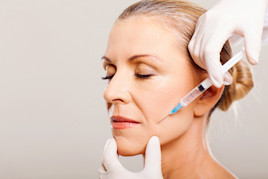
Collagen injection.
Collagen, a normal substance of the body, is injected under the skin
to "stretch" and "fill out" certain types of
superficial and deep soft scars. Collagen treatment usually does not
work as well for ice-pick scars and keloids. Collagen derived from
cows or other non-human sources cannot be used in people with
autoimmune diseases. Human collagen or fascia is helpful for those
allergic to cow-derived collagen. Cosmetic benefit from collagen
injection usually lasts 3 to 6 months. Additional collagen injections
to maintain the cosmetic benefit are done at additional cost.
Autologous fat transfer.
Fat is taken from another site on your own body and prepared for
injection into your skin. The fat is injected beneath the surface of
the skin to elevate depressed scars. This method of autologous (from
your own body) fat transfer is usually used to correct deep contour
defects caused by scarring from nodulocystic acne. Because the fat is
reabsorbed into the skin over a period of 6 to 18 months, the
procedure usually must be repeated. Longer lasting results may be
achieved with multiple fat-transfer procedures.
Dermabrasion.
This is thought to be the most effective treatment for acne scars.
Under local anesthetic, a high-speed brush or fraise used to remove
surface skin and alter the contour of scars. Superficial scars may be
removed altogether, and deeper scars may be reduced in depth.
Dermabrasion does not work for all kinds of scars; for example, it may
make ice-pick scars more noticeable if the scars are wider under the
skin than at the surface. In darker-skinned people, dermabrasion may
cause changes in pigmentation that require additional treatment.
Microdermabrasion.
This new technique is a surface form of dermabrasion. Rather than a
high-speed brush, microdermabrasion uses aluminum oxide crystals
passing through a vacuum tube to remove surface skin. Only the very
surface cells of the skin are removed, so no additional wound is
created. Multiple procedures are often required but scars may not be
significantly improved.
Laser Treatment.
Lasers of various wavelength and intensity may be used to recontour
scar tissue and reduce the redness of skin around healed acne lesions.
The type of laser used is determined by the results that the laser
treatment aims to accomplish. Tissue may actually be removed with more
powerful instruments such as the carbon dioxide laser. In some cases,
a single treatment is all that will be necessary to achieve permanent
results. Because the skin absorbs powerful bursts of energy from the
laser, there may be post-treatment redness for several months.
Skin Surgery.
Some ice-pick scars may be removed by "punch" excision of
each individual scar. In this procedure each scar is excised down to
the layer of subcutaneous fat; the resulting hole in the skin may be
repaired with sutures or with a small skin graft. Subcision is
a technique in which a surgical probe is used to lift the scar tissue
away from unscarred skin, thus elevating a depressed scar.
Skin grafting may be necessary
under certain conditions—for example, sometimes dermabrasion unroofs
massive and extensive tunnels (also called sinus tracts) caused by
inflammatory reaction to sebum and bacteria in sebaceous follicles.
Skin grafting may be needed to close the defect of the unroofed sinus
tracts.
Treatment of keloids.
Surgical removal is seldom if ever used to treat keloids. A person
whose skin has a tendency to form keloids from acne damage may also
form keloids in response to skin surgery. Sometimes keloids are
treated by injecting steroid drugs into the skin around the keloid.
Topical retinoic acid may be applied directly on the keloid. In some
cases the best treatment for keloids in a highly susceptible person is
no treatment at all.
In summary, acne scars are caused by the
body’s inflammatory response to acne lesions. The best way to prevent
scars is to treat acne early, and as long as necessary. If scars form, a
number of effective treatments are available. Dermatologic surgery
treatments should be discussed with a dermatologist.
|