




| |
AcneNet Article
Are laser and light treatments really light years ahead of
conventional acne therapy?
Tired of applying messy lotions and remembering to take medications
as prescribed? If so, you may be wondering if a laser or light
therapy is right for you. To shed some light on these therapies,
this article explains what research studies show and why lasers and
light therapies still are not routinely prescribed to treat acne.
What Research Shows
Data from clinical trials is limited. The U.S. Food and Drug
Administration (FDA) classifies laser and light therapies as
procedure-oriented, so the stringent, long-term studies necessary
for approval of drugs is not required. As such, more comparative
studies are needed to determine long-term effects and to perfect
these technologies. However, data from recent studies indicates that
laser and light therapies show much promise in treating acne. Here’s
what is known:
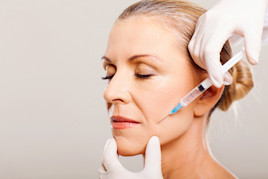
Blue-light therapy.
The FDA
approved narrow-band, high-intensity blue-light therapy for treating
acne. Now widely advertised, this is probably the best-known light
therapy for acne treatment. Blue light works by killing the
acne-causing bacteria, P. acnes, and is being used to treat
inflammatory acne vulgaris that has not responded to other
acne therapies. The blue-light products of
today do not contain ultraviolet (UV) light, which was a staple of
former light therapy used to treat acne. UV light can damage skin
and is no longer used to treat acne.
Patients receive blue-light therapy in increments. Generally, eight
sessions are given over a four-week period, and each session lasts
about 15 minutes. Side effects tend to be mild and include temporary
pigment changes, swelling of the treated areas, and dryness. As the
results from the following studies show, many patients — but not all
— see noticeable improvement with about 55% clearance:
-
31 patients
with symmetrical (same on both sides) facial acne received
blue-light treatment on 1 side of their faces. Blue-light therapy
was given twice a week for four consecutive weeks. The other side
of each patient’s face did not receive any treatment so that
researchers could judge the effectiveness of the blue-light
therapy. The researchers concluded that blue-light therapy is an
effective acne treatment unless the patient has
nodulocystic acne
lesions, which tend to worsen when treated with blue light.
(Taiwan)1
-
25 patients with inflammatory acne on
their faces had half of their face treated with blue-light therapy
(8 sessions over 4 weeks) and the other half with clindamycin (a
topical antimicrobial shown successful in treating acne). Patients
were instructed to apply the clindamycin twice a day for four
weeks. After four weeks, the clindamycin side showed a 22.25%
improvement, and the side treated with blue light improved by 39%.
However, after eight weeks and without further treatment, the side
treated with clindamycin was better able to maintain results.
(United States)2
-
10, 13, and 25 patients were enrolled
in three separate studies designed to learn more about the effects
of blue-light therapy on papulo-pustular (inflammatory) acne. In
all three studies, more than 80% of the patients treated with
blue-light therapy responded to the treatment. The patients who
responded saw a 59% to 67% reduction in inflammatory acne lesions.
(Israel)3
-
30 patients with mild to moderate acne
were treated twice a week with blue-light therapy for up to five
weeks. After five weeks, acne lesions decreased by 64%. However,
not all patients saw improvement; 20% remained unchanged or
experienced a worsening of their acne. (Japan)4
As you can see,
the number of patients involved in these studies is small. Clinical
trials conducted to test new drugs generally must enroll hundreds to
thousands of participants before submitting the data to the FDA for
consideration. With such small numbers, statistically valid
conclusions cannot be drawn. Research also is needed to learn the
long-term effects. At present, blue-light therapy appears to improve
acne vulgaris in some individuals. This therapy appears most
effective for inflammatory acne lesions and may not be suitable for
patients with nodulocystic
acne.
Pulsed light and heat energy (LHE) therapy. This treatment
combines pulses of light and heat, which researchers believe target
two causes of acne.
It is known that LHE destroys P. acnes, the acne-causing
bacteria. LHE also may decrease sebum (oily substance) production by
shrinking the sebaceous glands. A system that combines pulses of
green light and heat has been approved by the FDA for treating mild
to moderate acne. Here’s what a recent study showed:
-
19 patients with mild to moderate acne
received two LHE treatments per week for four weeks. At the end of
eight treatments, researchers saw significant clearance in both
inflammatory and non-inflammatory lesions. Further improvement was
seen one month after the last treatment. The most significant
reduction in lesions was observed two months after the last
treatment was given. Researchers concluded that LHE technology is
effective and safe for treating acne vulgaris. (Israel)5
ALA + light therapy. Studies are
investigating the effectiveness of this therapy in treating acne.
Patients receiving this treatment undergo a two-step process. First,
a solution of 5-aminolevulinic acid (ALA) is applied to the skin to
be treated. ALA is a medication that increases sensitivity to light.
When used to treat acne, the ALA is kept on the skin for a period of
time ranging from 15 to 60 minutes. The length of time depends on
the severity of the acne. Step two involves removing the ALA and
treating the skin with light therapy. Since ALA makes the skin more
light sensitive, patients are instructed to use sun protection for
48 hours after treatment.
Findings from research studies indicate that treatment with blue or
red light after the application of ALA is effective. However, as the
following shows, red light may produce some undesirable side
effects:
-
10 patients who received multiple
treatments of ALA + red-light therapy on their backs had a
statistically significant reduction in inflammatory acne lesions.
However, the side effects, such as temporary darkening of the skin
and development of folliculitis (an inflammation of hair
follicles that resembles acne), limit recommendation of this
treatment. (United States)6
A recent study that looked at using ALA
followed by blue light concludes that this therapy may be suitable
for acne treatment. (Israel)7
Diode laser. A few studies have looked at the possibility of
treating acne with the 1450-nm diode laser. One study found that the
1450-nm diode laser effectively treats inflammatory acne on the
back. Recently, a study looked at using this laser to treat facial
acne:
-
19 patients with inflammatory acne on
their face were treated with the 1450-nm diode laser to evaluate
the safety and effectiveness of using this laser to treat facial
acne. Every patient saw a significant reduction in acne lesions.
After one treatment, lesion counts decreased 37%. A 58% decrease
was seen after two treatments, and lesion counts decreased by 83%
with three treatments. The researchers found that the pain
associated with diode-laser treatment is well tolerated with a
topical anesthetic. Side effects in this study were limited to
temporary redness and swelling at the treatment sites. (United
States)8
Pulsed dye laser. Two studies
looked at treating facial acne with the pulsed dye laser. Results
were inconsistent.
-
41 patients with mild to moderate
inflammatory acne on their faces were recruited. These patients
were randomly selected to receive either one treatment with a
pulsed dye laser or a treatment that they thought was the
investigational therapy (placebo). After 12 weeks, the patients
treated with the pulsed dye laser had a statistically significant
reduction in acne lesions — 53% for total lesions and 49% for
inflammatory lesions. A significant reduction in lesions was not
observed in the patients treated with the placebo. Researchers
concluded that the pulsed dye laser improves inflammatory facial
acne after just one treatment without serious side effects and
that future study is needed. (United Kingdom)9
-
40 patients aged 13 and older who had
facial acne received either one or two pulsed dye laser treatments
to one-half of the face. The other half of the face was left
untreated. After 12 weeks, researchers found no significant
difference between the treated and untreated sides. This study
concluded that treatment with the pulsed dye laser did not
significantly improve facial acne and more research should be
conducted before this laser therapy is recommended for acne.
(United States)10
Still Not Routinely Prescribed
While the results from these studies are promising, the use of
lasers and light therapies to treat acne is still in the
investigational stage and may not be the first choice for treating
acne. If you are considering a laser or light therapy to treat acne,
you should know the following:
More research is needed. Controlled studies with large number
of patients are needed to:
-
Know which therapy is best for which
patient. To date, it appears that laser and light therapies are
more effective on adults. However, the profile of a good candidate
for each type of treatment still needs to be developed.
-
Evaluate the effectiveness of each
therapy. To date, consistent results have not been obtained in the
research studies.
-
Determine if there are long-term side
effects.
-
Find out if the results last after the
treatments are discontinued.
Studies that can provide long-term data
are in the planning stages.
Many patients require multi-targeted approach. Acne develops
when one or more of the following occurs: excess sebum production,
rapid production of P. acnes, skin cells shed too quickly,
and release of inflammatory substances. For treatment to work it
must interfere with what is causing the acne. This is why the acne
treatment prescribed by a dermatologist often requires patients to
use more than one medication.
Since some of the laser and light therapies target only one cause, a
patient’s acne may not resolve. For example, blue-light therapy
targets only P. acnes, so acne will resolve only when this is
the sole cause. If other factors are present, blue-light therapy
will not clear the acne.
Insurance may not cover. Most insurance plans classify the
light and laser treatments used to treat acne as “emerging
technologies.” Insurance generally does not cover treatments
classified as “emerging technologies.” A patient who opts for the
FDA-approved blue-light therapy can expect to pay about $100 to $200
per treatment session. Since eight sessions are typically needed,
the average out-of-pocket cost is $800 to $1,600 over the
recommended four-week period.
With time, research, and experience, laser and light therapies may
eventually be light years ahead of traditional acne therapies.
Studies indicate that these treatments offer a promising
non-invasive alternative. Until more is known, laser and light
therapies offer an alternative for individuals whose acne has not
responded to traditional acne therapies.
References:
Tzung TY et al.
“Blue light phototherapy in the treatment of acne.”
Photodermatology,
Photoimmunology & Photomedicine. 2004 October; 20(5):266-9.
“New blue light edges
out clindamycin.” Dermatology Times. 2004 March:25(3):40.
Elman M et al. “The
effective treatment of acne vulgaris by a high-intensity, narrow
band 405-420
nm light source.” Journal of Cosmetic and Laser Therapy.
2003 June;5(2):111-7Kawada A et al. “Acne phototherapy with a high-intensity,
enhanced, narrow-band, blue light
source: an open study and in vitro investigation.” Journal of
Dermatologic Science. 2002
November;30(2):129-35.
Elman M, Lask G. “The
role of pulsed light and heat energy (LHE) in acne clearance.”
Journal of
Cosmetic and Laser Therapy. 2004 June;6(2):91-5.
Hongcharu W et al.
“Topical ALA-photodynamic therapy for the treatment of acne vulgaris.”
Journal of Investigative Dermatology. 2000
August;115(2):183-92.
Askkenzai H et al.
“Eradication of Propionibacterium acnes by its endogenic porphyrins
after
illumination with high intensity blue light.” FEMS Immunology
and Medical Microbiology. 2003
January 21:35(1):17-24.
Friedman, PM et al.
“Treatment of inflammatory facial acne vulgaris with the 1450-nm
diode laser: a
pilot study.” Dermatologic Surgery. 2004 February;30(2 Pt
1):147-51.
Seaton ED et al.
“Pulsed-dye laser treatment for inflammatory acne vulgaris:
randomised controlled
trial.” Lancet. 2003 October 25;362(9393):1347-52.
Orringer JS et al.
“Treatment of acne vulgaris with a pulsed dye laser: a randomized
controlled
trial.” Journal of the American Medical Association.
2004 June 16;291(23):2834-9.

An educational program brought to you by the American Academy of
Dermatology. |
 |
|