








| |
Depressed Acne Scars: Effective Treatment Available
Most people who scar after the acne
clears see soft, saucer-like depressions or pits on their skin.
Sometimes the skin loses its underlying support and develops a wavy
texture. As we age, these scars often become even more noticeable.
The good news is that no one has to live with these scars.
3 Types of Depressed Acne Scars
| |
|
|
 |
 |
|
Rolling acne scars
These scars cause a wavy texture in the skin. |
Boxcar acne scars
Often looking like large pores, boxcar scars cause boxlike
walls to form on the skin. |
| |
|
|
 |
Rolling acne scars and boxcar acne scars - These photographs were
published in the Journal of the American Academy of Dermatology, 2001 Jul; 45(1):109-17. Jacob
CI, Dover JS, Kaminer MS.
“Acne
scarring: a classification system and review of treatment
options.” Copyright Elsevier (2001).
Icepick acne scars - This photograph is
used with permission of
the American Academy of Dermatology National Library of Dermatologic Teaching Slides. |
|
Icepick acne scars
When these scars form, it looks like a tiny ice pick
punctured the skin. Icepick scars leave deep pits with
narrow openings. |
Treatment Options for Depressed Acne
Scars
Thanks to advances in medicine and technology, dermatologists have
many treatment options for depressed acne scars. Advances have even
lead to improvements in treatments that have been used for years. If
you see a dermatologist for treatment, your own treatment plan may
include one or more of the following:
Acne Scar Surgery
Acne scar surgery remains one of the most effective treatment
options for treating depressed acne scars. With many types of acne
scar surgery now available, dermatologist can remove, raise, fill,
and even separate the scar tissue from the underlying skin.
The purpose of all acne scar surgery is to replace a large, deep
scar with a smaller, flatter scar, which will be less noticeable and
more likely to fade. After your skin heals from the surgery, your
dermatologist may treat the smaller, flatter scar with laser skin
resurfacing. This tends to make the scar even less noticeable.
Surgery is usually performed in a dermatologist’s office. Before the
surgery, patients usually receive a local anesthesia (numbs only the
area to be treated) or light sedation (you remain awake). The more
common acne scar surgeries that dermatologists perform are:
-
Punch excision – A surgical
instrument that looks like a round cookie cutter is used to
remove the entire scar.
-
Punch elevation – After
removing the scar, your dermatologist carefully raises the
remaining tissue so that when it heals, it will be level with
the rest of your skin.
-
Punch graft – After removing
the scar, your own skin is used to fill the opening.
-
Subcutaneous incision – Your
dermatologist uses a surgical probe to separate the scar tissue
from the skin, which will raise the skin and flatten the scarred
surface.
Before-and-After Pictures: Acne Scar
Surgery
| |
|
|
 |
 |
|
Before - Man has rolling
acne scars and boxcar acne scars. |
After - 6 months after
subcutaneous incision, a type of acne surgery used to raise
the skin and flatten the surface. |
| |
|
|
These photographs were published in the Journal
of the American Academy of Dermatology, 2001 Jul; 45(1):109-17. Jacob
CI, Dover JS, Kaminer MS.
“Acne
scarring: a classification system and review of treatment
options.” Copyright Elsevier (2001). |
What you can expect after acne scar
surgery: You may not see immediate improvement. There can be
downtime. You may need to treat the wounds at home by changing
bandages and soaking the treated skin. If you undergo subcutaneous
incision, you may see bruising that can last for 1 or 2 weeks. Your
dermatologist can tell you what you can expect and how many times
you will need to return for treatment.
Laser Skin Resurfacing
Studies show that laser skin resurfacing can effectively treat
depressed acne scars. In one such study, 158 patients aged 18 to 46
years old were treated with an ablative laser (creates a visible
wound). For patients with icepick scars or shallow boxcar scars, the
results were good to excellent. Even some patients with rolling
scars had good results when dermatologists used a type of laser
called the dual-mode laser. Deep boxcar scars showed least
improvement, but a few patients with these scars had good results.
What you can expect after laser skin resurfacing: What you
experience depends on the type of laser(s) used. Ablative lasers
cause visible wounds, so you will have downtime. You also will need
to care for the skin with soaks, antibiotic ointment, and dressings.
Most people return to normal activities in about 2 weeks, which is
when you will begin to see improvement. Many people continue to see
improvements for up to 18 months.
Non-ablative lasers do not cause visible wounds. Many people can
return to most activities immediately after treatment. To see
improvement, a series of treatments is often necessary with these
lasers.
Before-and-After Pictures: Acne Scar Surgery and Laser Skin
Resurfacing
To deliver the best results, dermatologists often combine treatments
for acne scars.
|
 |
 |
|
Before - Woman has boxcar
acne scars. |
After - 3 months after
treatment with acne scar surgery and laser skin resurfacing. |
| |
|
These photographs were published in the Journal
of the American Academy of Dermatology, 2001 Jul; 45(1):109-17. Jacob
CI, Dover JS, Kaminer MS.
“Acne
scarring: a classification system and review of treatment
options.” Copyright Elsevier (2001). |
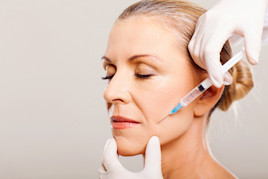
Fillers
With improved, longer-lasting fillers, this treatment option has
become very popular. People like that fillers can quickly diminish
the appearance of acne scars. They also like that most fillers allow
them to return to everyday activities immediately. The only
drawback: Most fillers are temporary.
Your dermatologist may inject collagen, hyaluronic acid, PMMA (polymethylmethacrylate),
your own fat, or another filler to plump up the scars. PMMA is the
only permanent filler.
Most temporary fillers last about 3 to 6 months. When a
dermatologist fills the scars with your own fat, the results can
last 1 to 3 years, but there is downtime with this filler. To get
the fat, your dermatologist will perform liposuction, which requires
downtime.
What you can expect after treatment
with a filler: While you can usually return to your everyday
activities immediately, redness and swelling are normal. Some minor
bruising also may be visible. To alleviate these, your dermatologist
may recommend icing the area for 15 to 20 minutes before you leave.
Makeup can usually be applied before you leave.
To avoid increased swelling and bruising, you should not exercise
until the next day. You also will want to avoid touching the treated
area for about 3 days, unless your dermatologist instructs
otherwise.
Chemical Peels
For some people with acne scars, a chemical peel may be part of the
treatment plan. If your dermatologist recommends a chemical peel, a
high-potency acid will be applied to the skin to remove the top
layer of skin. Very strong peels can reach even deeper into the
skin.
What you can expect after a chemical peel: You can expect to
see some redness. The amount of redness you see will depend on the
type of peel used. It is important to know that a chemical will
cause your skin to peel. Over the next 1 to 14 days, new skin will
appear. If you had a deep or moderately deep peel, there will be
some downtime.
All peels require some follow-up care. Protecting your skin from the
sun after a chemical peel is necessary to help prevent unwanted side
effects such as infection and scarring. You will be given specific
instructions to follow, which will include everything from how to
wash your skin to sun protection. It is important to follow these
instructions.
Microdermabrasion
While not a leading treatment for acne scars, microdermabrasion can
be effective for very mild acne scarring. During this procedure, a
dermatologist uses a machine to remove the top surface layer of
skin. With a series of microdermabrasion sessions, the skin can
repair itself and shallow scars tend to become less noticeable.
Patients like that microdermabrasion does not require downtime and
is considered painless.
What you can expect after microdermabrasion: After a
microdermabrasion procedure, the treated skin may be pink or
slightly red and swollen. If the skin is red and swollen, this
should disappear within a day.
You will be given a skin-care plan that includes sun protection. Sun
protection helps ensure the best possible results and reduces the
risk of side effects.
Dermabrasion
While laser skin resurfacing has largely replaced dermabrasion, this
remains an effective treatment option for some acne scars.
Dermabrasion, unlike the other treatments for acne scarring, is
usually performed in a surgical center. Before the procedure, the
skin will be cleansed and anesthetized (numbed). Usually a spray is
used to anesthetize the area and a sedative is given. Sometimes a
general anesthesia (puts the person to sleep) is used instead.
To perform dermabrasion, your dermatologist will move a handheld
device back and forth or in a circular motion over the skin. An
extremely sharp rotating blade will gradually remove the skin, which
can remove the acne scars.
Dermabrasion must be performed carefully — one section at a time. If
the entire face will be treated, the procedure lasts about 2 hours.
To treat a smaller area, such as the upper lip, takes about 30
minutes. After the skin has been treated, particles from the device
are rinsed away. Next compresses are applied to control the
bleeding, and the wound is dressed.
What you can expect after
dermabrasion: The treated skin will feel raw and sore, and you
may be groggy. You will need 5 to 7 days to recover at home.
Instructions for at-home care will include how to change the
dressings and care for your skin. Following this at-home care is
essential to prevent side effects and obtain the best possible
results. If you have any questions, be sure to ask.
While new skin appears within 10 days, it is normal for the skin to
continue improving for several months. During this time, you may
notice slight redness and swelling.
Trust Your Dermatologist
If you want to know what treatment is best for your acne scars, be
sure to talk with a dermatologist. There is a lot to consider when
someone wants to treat acne scars. This includes the types of acne
scars, what results you can expect, and your medical history. A
dermatologist can create a treatment plan that is right for you.
References:
Jacob CI, Dover JS, Kaminer MS. “Acne scarring: a classification
system and review of treatment options.” Journal of the American
Academy of Dermatology July 2001; 45: 109-17.
Lee DH, Choi YS, Min SU et al. “Comparison of a 585-nm pulsed
dye laser and a 1064-nm Nd:YAG laser for the treatment of acne
scars: A randomized split-face clinical study.” Journal of the
American Academy of Dermatology May 2009; 60: 801-7.
Rivera AE. “Acne scarring: a review and current treatment
modalities.” Journal of the American Academy of Dermatology
October 2008; 59: 659-76.

All
content solely developed by the American Academy of Dermatology |
 |
 |
|
Before treating acne scarring, several factors
must be considered, including the type of scars, what
results you expect, and your medical history. |
|

|
|
|