





| |
Prescription Medications for Treating Acne
A variety of prescription medications
are used today to clear acne. Topical (applied to the skin)
medications may be prescribed for mild to severe acne. Systemic
(works internally) therapy is needed to treat severe acne and may be
used for moderate cases. These medications, which play an important
role in acne treatment, attack the different factors that lead to
acne. To achieve long-term control and resolution, dermatologists
may combine therapies. The following describes the prescription
medications used in the United States to treat acne:
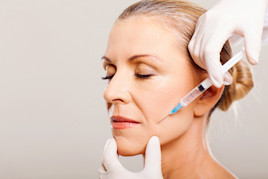
Interlesional Corticosteroid
Injection
When an acne cyst becomes severely inflamed, there is a good chance
that it will rupture and scarring may result. To treat these
severely inflamed cysts and prevent scarring, dermatologists may
inject such cysts with a much-diluted corticosteroid. This lessens
the inflammation and promotes healing. An interlesional
corticosteroid injection works by "melting" the cyst over a period
of 3 to 5 days.
Isotretinoin
Isotretinoin is a potent oral retinoid that is reserved for
treatment of very severe cystic acne and severe acne that has proven itself resistant to
other medications. For more information about isotretinoin, see
Treating Severe Acne.
Oral Antibiotics
For patients with moderate to severe and persistent acne, oral
antibiotics have been a mainstay of therapy for years. Like topical
antimicrobials, oral antibiotics work to reduce the
P. acnes
population (a contributing factor in acne), which, in turn,
decreases inflammation. Treatment with oral antibiotics usually
begins with a higher dosage, which is reduced as acne resolves.
Generally, antibiotics are prescribed for six months or less.
Over time, the P. acnes bacteria
can become resistant to the antibiotic being used to treat it. When
resistance occurs, acne is no longer controlled. Another antibiotic
or alternative treatment can be prescribed. Numerous studies support
the effectiveness of the following oral broad-spectrum antibiotics,
which are used to treat acne in the United States:
-
Erythromycin. It is effective
against a broad spectrum of bacteria, including P. acnes.
The most common side effect is irritation of the gastrointestinal
tract.
-
Tetracycline and derivatives.
Tetracyclines reduce the papules and
pustules (inflammatory lesions) of acne. These medications
should not be taken by children younger than 8 years of age
because they can affect growth and stain teeth. They should also
not be taken by a woman who is pregnant or breast feeding. During
pregnancy and breastfeeding, tetracyclines can affect the
development of the child’s bones and teeth, leading to skeletal
defects.
A typical tetracycline regimen for
treating moderate to severe acne starts with a dose of 500 to 1000
milligrams a day, which is decreased as improvement occurs.
Long-term, low-dose tetracycline therapy may be continued for many
months to suppress acne. Higher doses may be prescribed for very
severe acne.
Two synthetic derivatives of
tetracycline used to treat acne are doxycycline and
minocycline. Doxycycline proves especially effective in
treating inflammatory acne. It can cause sun sensitivity in some
patients. Minocyline has a long history of use in treating acne.
It is often effective in treating acne that has not responded to
other oral antibiotics. Minocycline also seems to produce fewer
incidents of antibiotic resistance.
Oral Contraceptives
Oral contraceptives have been shown to effectively clear acne in
women by suppressing the overactive sebaceous glands and can be used
as long-term acne therapy. However, oral contraceptives should not
be prescribed to women who smoke, have a blood-clotting disorder,
are older than 35 or have a history of migraine headaches—without
the advice of a gynecologist.
Topical Antimicrobials
Topical antimicrobials work to inhibit the
P. acnes
populations and are used to treat patients with mild to moderately
severe inflammatory acne. They may be used alone or combined with a
medication that works on another factor that leads to acne aside
from P. acnes. A dermatologist can determine whether a
topical antimicrobial is appropriate for a patient and if so which
topical antimicrobial should be prescribed. Prescription topical
antimicrobials used to treat acne vulgaris
in the United States include:
-
Azelaic acid. Naturally
occurring in the skin, azelaic acid is used to treat mild to
moderate inflammatory and non-inflammatory acne. It is believed
that azelaic acid clears acne by reducing the populations of P.
acnes, decreasing the abnormal shedding of skin cells and
reducing inflammation. This medication has also proven effective
in treating the dark spots that develop in some acne patients with
skin of color. Azaleic acid is well tolerated by most people and
can be safely used for years. Side effects may include skin
dryness and lightening of the skin where applied.
-
Benzoyl peroxide. Benzoyl
peroxide works by killing P. acnes. However, it does not
have anti-inflammatory abilities. It is available in a wide range
of strengths and can be found as a gel, lotion, cleanser, cream
and wash. Many acne preparations include benzoyl peroxide because
research shows that benzoyl peroxide increases the effectiveness
of some medicines, such as erythromycin and clindamycin. When used
in combination with antibiotics, benzoyl peroxide also reduces the
likelihood of a patient developing resistance to the antibiotic.
The most common side effects are skin irritation, the potential to
bleach hair and fabrics as well as possible allergic reaction.
-
Clindamycin. A semi-synthetic
antibiotic, topical clindamycin has a long history of successfully
treating acne. It works by reducing P. acnes and decreasing
inflammation. In topical form, clindamycin has proven safe and is
well tolerated. Skin dryness and irritation are possible side
effects. It is important to use as directed to decrease bacterial
resistance that can occur with antibiotic use.
-
Erythromycin. This topical
antibiotic is active against a broad spectrum of bacteria,
including P. acnes. Topical erythromycin, which is an
antimicrobial and anti-inflammatory, is used primarily to treat
acne. When topical erthyromycin is combined with benzoyl peroxide,
the combination proves to be quite effective as the patient gets
the effects of two antimicrobial agents. Like topical clindamycin,
erythromycin may cause skin dryness and possible irritation. It is
important to use as directed to decrease bacterial resistance that
can occur with antibiotic use.
-
Sodium sulfacetamide. A
topical antibiotic that inhibits
P. acnes and
opens clogged pores, sodium sulfacetamide is effective in treating
inflammatory acne. Many products containing sodium sulfacetamide
include sulfur. Some patients do not like the smell of the sulfur
or its grittiness. Usually, the newer products that contain sulfur
do not have these problems.
Topical Retinoids
Prescribed to treat acne ranging from mild to moderately severe,
topical retinoids are a derivative of vitamin A and considered a
cornerstone in acne treatment. Retinoids work to unclog pores and
prevent whiteheads and blackheads from forming. Topical retinoids
can irritate the skin and increase sun sensitivity so it is
important to use sun protection and follow the dermatologist’s
directions to maximize effectiveness. An added benefit in using
topical retinoids is that they may help diminish the signs of aging,
such as fine lines and wrinkles. Topical retinoids currently
prescribed for acne treatment in the United States include:
-
Adapalene. A synthetic
retinoid applied as a gel or cream, adapalene unclogs pores and
possesses moderate to potent anti-inflammatory abilities.
Improvement is usually seen in 8 to 12 weeks. Side effects include
minor skin irritation and dryness.
-
Tazarotene. A synthetic
retinoid available as a gel or cream, it works to keep the skin’s
pores clear and has proven effective in treating acne. This
medication should not be used by women who are pregnant, and
effective contraception is needed while taking tazarotene because
the medication has produced birth defects in animals. Skin
irritation is a possible side effect.
-
Tretinoin. The first retinoid
developed for topical use, tretinoin is a natural retinoid. It
works to gradually unclog pores and keep them unplugged. In the
past, many patients found tretinoin too harsh for their skin;
however, the newer forms are proving less irritating. Side effects
include redness, scaling, dryness, itching and burning. If these
occur, talk with the dermatologist who prescribed tretinoin as
these side effects can be managed by adjusting the amount applied
and when it is applied.
Reference:
Thiboutot, D. “New Treatments and Therapeutic Strategies for Acne.”
Archives of Family Medicine 2000: 9:179-187.

All
content solely developed by the American Academy of Dermatology |
 |
|