






|
Treating
Severe Acne
Severe acne is characterized by deep
cysts, inflammation, extensive damage to the skin and scarring. It
requires an aggressive treatment regimen and should be treated by a
dermatologist. Severe, disfiguring forms of acne can require years
of treatment and may experience one or more treatment failures.
However, almost every case of acne can be successfully treated.
Physical methods and prescription
medications that dermatologists use to treat severe acne include:
Drainage and Surgical
Excision
Some large cysts do not respond to medication and may require
drainage and extraction. Drainage and extraction, or “acne surgery”
as it is also called, should not be performed by patients.
Dermatologists are trained in the proper technique and perform acne
surgery under sterile conditions. Patient attempts to drain and
extract comedones by squeezing or picking, can lead to infection,
worsening of the acne and scarring.
|
 |
|
Severe acne requires an aggressive
treatment
regimen and should be treated by a dermatologist. |
|
(Photo used with permission of the
American Academy of Dermatology National Library of Dermatologic
Teaching Slides) |
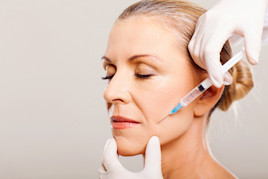
Interlesional
Corticosteroid Injection
When an acne cyst becomes severely inflamed, there is a good chance
it will rupture and scarring may result. To treat these severely
inflamed cysts and prevent scarring, dermatologists may inject such
cysts with a much-diluted corticosteroid. This lessens the
inflammation
and promotes healing. An interlesional corticosteroid injection
works by "melting" the cyst over a period of
3 to 5 days.
Isotretinoin
Isotretinoin is a potent drug reserved for treating severe
cystic acne and acne
that has proven itself resistant to other medications. Isotretinoin
is a synthetic (man-made) retinoid (form of vitamin A) that comes in
pill form. It is usually taken once or twice a day for 16 to 20
weeks.
Today, it is the most effective acne
treatment available because it is the only acne treatment that works
on all four factors that predispose a person to acne - excess oil
production, clogged skin pores,
P. acnes
and inflammation. The remissions achieved with isotretinoin usually
last for many months to many years. For many patients, only one
course of isotretinoin therapy is needed.
The effectiveness of isotretinoin in
treating severe acne is shown in the following before-and-after
photos:
|
 |
(Photos used with permission of the American Academy of
Dermatology National Library of Dermatologic Teaching Slides) |
|
Severe acne before treatment with
isotretinoin |
After treatment with isotretinoin |
|
While isotretinoin is the most
effective acne treatment available, it cannot be prescribed to
everyone due to a number of potential side effects—some serious. One
of the most serious side effects is the potential to cause severe
birth defects in a developing fetus. For this reason, the U.S. Food
and Drug Administration (FDA) requires that women not be (or become)
pregnant while taking isotretinoin. FDA regulations require women of
childbearing age to take 2 pregnancy tests prior to beginning
isotretinoin therapy and use 2 forms of birth control for 1 month
before therapy begins, while taking the drug and for 1 full month
after therapy. It is also important that women not breast feed
during this time. Women who wish to become pregnant after taking
isotretinoin should talk to their dermatologist and gynecologist
about when it is safe to get pregnant after receiving isotretinoin
therapy.
Other possible severe side effects that
may occur while taking isotretinoin include:
-
Severe pain in the chest or abdomen
-
Trouble swallowing or painful
swallowing
-
Severe headache, blurred vision or
dizziness
-
Bone and joint pain
-
Nausea or vomiting
-
Diarrhea or rectal bleeding
-
Depression
-
Dryness of the skin, eyes and nose
-
Thinning hair
If any side effect occurs, the
patient’s dermatologist or other healthcare practitioner should be
contacted immediately because some of these side effects can lead to
serious health problems.
While taking isotretinoin, patients are
regularly monitored for side effects through follow-up visits. For
most people, these side effects are tolerable and not a reason to
discontinue therapy before remission is achieved. However, it is
important to keep appointments for follow-up visits because
monitoring can reveal conditions that a patient might not notice.
For example, a patient may not realize a rapid increase in bad
cholesterol that is detected through a blood test.
The decision to use isotretinoin should
be made jointly by patient and dermatologist. When used with all due
caution under close medical supervision, isotretinoin can resolve
severe acne that has not responded to other therapy. It has proven
especially effective in resolving cystic acne, a severe form of acne
that usually does not respond to other therapies.
For a substantial number of patients,
one course of isotretinoin therapy is all they will ever need. A
small number of patients require more than one course of
isotretinoin therapy to control severe acne.
It is important to take isotretinoin as
prescribed—even if the skin clears before all of the pills have been
taken—to prevent relapse. At the end of an effective course of
isotretinoin therapy, all or most of the acne lesion will have
cleared. Patients may notice residual erythematous (reddish) macules
(flat spots) where acne lesions were present. These macules are not
scars, and they will fade in 6 to 8 weeks.
After therapy, patients should continue
to follow the Skin Care
Guidelines for People with Acne.
Oral Antibiotics
Oral antibiotics have been a mainstay of therapy for severe acne for
many years. Like topical antibiotics, oral antibiotics work to
reduce the P. acnes population (a contributing factor in
acne), which, in turn, decreases inflammation. Treatment with oral
antibiotics usually begins with a high dosage, which is reduced as
the acne resolves. Over time, the P. acnes bacteria can
become resistant to the antibiotic being used to treat it. When this
happens, another antibiotic can be prescribed. Numerous studies
support the effectiveness of the following broad-spectrum oral
antibiotics that are used to treat acne in the United States:
doxycline, erythromycin, minocycline and tetracycline. For
information about each of these oral antibiotics, see
Prescription Acne Medications.
Oral Contraceptives
Oral contraceptives have been shown to effectively clear acne in
women by suppressing the overactive sebaceous glands. Oral
contraceptives can be used as long-term acne therapy; however, this
medication should not be prescribed to women who smoke, have a
blood-clotting disorder, are older than 35 or have a history of
migraine headaches—without the advice of a gynecologist.
Spironolactone, a synthetic steroid,
may be used in combination with oral contraceptives to treat acne in
adult females. Spironolactone inhibits
androgen
production. Side effects include irregular menstruation, breast
tenderness, headache and fatigue.

An educational program brought to you by the American Academy of
Dermatology. |