






|
ActinicKeratosesNet Article
When Sun Exposure Unavoidable, Think Photoprotection
Dermatologists routinely tell their
patients that sun avoidance - staying out of the sun completely - is
the most effective way to protect their skin from the damaging
effects of the sun’s ultraviolet (UV) rays. Research shows that
premature aging, actinic keratoses (AKs), and skin cancer are
sun-induced conditions. While sun avoidance is effective, this
advice may not be practical, particularly if a person’s occupation
or lifestyle involves outdoor activities.
Since skin should receive as little
exposure to UV rays as possible, comprehensive sun-protection
practices are recommended when sun avoidance is not possible.
Photoprotection is an important part of a comprehensive
sun-protection plan, so it is important to know what photoprotection
is and how to include it in a sun-protection plan. “Photoprotection”
can be defined as “the use of physical and/or chemical agents to
prevent the skin-damaging effects from UV radiation in sunlight.”
Physical photoprotection is provided by clothing, umbrellas,
parasols, awnings, trees, and tents. Sunscreens provide chemical
photoprotection.
Before heading outdoors, either to work
or for a day of fun, be sure to read the following which explains
what you need to know to “think photoprotection.” These principles
should be applied year round - not only on hot sunny summer days.
Select Clothing for its
Photoprotection Properties
Clothing with a high Sun Protection Factor (SPF) can block
nearly 98% of UVA and UVB radiation - a degree of protection
especially important for a person who:
-
Burns easily and is at high risk for
AKs, photoaging, skin cancer and other sun-induced skin conditions
-
Receives chronic and intense sun
exposure either through an occupation or leisure activity (e.g.,
farming, construction work, fishing, golfing, and gardening)
What gives clothing a high SPF is the
fabric. Tightly woven synthetic fabrics made from nylon or polyester
provide maximum photoprotection. Almost as photoprotective, tightly
woven cotton blends are more comfortable in hot and humid
conditions. Conversely, light-colored fabrics with a loose weave,
such as a white cotton t-shirt, do not provide adequate
photoprotection - especially when wet. To get maximum
photoprotection select dark colored, tightly woven clothing that
covers the skin. Long sleeves and pants are preferable.
If you will be wearing a garment
outdoors frequently, you may want to ask your dermatologist about
companies that specialize in photoprotective clothing. Your
dermatologist also may recommend a laundry additive that can
increase the photoprotection provided by clothing.
Since clothing plays such an important
role in photoprotection, some garments made specifically for outdoor
activities, such as hiking, print the garment’s SPF on a highly
visible tag. Fabrics used to make these clothes are woven
specifically to provide UV protection and are made to meet SPF
specifications.
In addition to wearing photoprotective
clothing, dermatologists recommend that anyone who spends time
outdoors during the day wear a wide-brimmed hat to shade the face
and neck as well as shoes that cover the entire foot.
Seek Shade Whenever Possible
In addition to wearing protective clothing, the American Academy
of Dermatology recommends that people seek shade whenever possible.
Tents, trees, awnings, and manmade shade structures all provide
photoprotection. Erecting a temporary open-air tent or permanent
shade structure can provide effective shade and ultraviolet
radiation protection for an outdoor area. Whenever possible, seek a
shady place.
Sunscreen Provides Photoprotection
for Exposed Skin
The American Academy of Dermatology recommends that anyone who
will be in the sun for 20 minutes or more wear a broad spectrum
(offers protection from both UVA and UVB rays) sunscreen with an SPF
of at least 30 on all exposed skin year-round.
Sunscreens are designed to aid the body’s
natural defense mechanisms in protecting against harmful ultraviolet
(UV) radiation from the sun. They work by absorbing, reflecting, or
scattering the sun’s rays on the skin. Since some UV light
gets through sunscreens, they should not be the only means of
protecting the skin from the sun’s UV rays.
To be effective, a sunscreen must be:
-
Broad-spectrum and have an SPF or 30
or more
-
Used on a regular basis, including
cloudy days since 80% of the sun’s UV rays pass through the
clouds
-
Applied to dry skin 15-30 minutes before going outdoors, and
reapplied approximately every two hours to all exposed skin
-
Applied to all bare skin - a lip balm that contains sunscreen with
an SPF 30 or higher protects the lips
-
Reapplied after perspiring or
swimming
Sunscreen
comes in many forms including creams, gels, lotions, and wax
sticks. The type of sunscreen used is a matter of personal
preference; however, it should be broad-spectrum, have an SPF of 30
or more, and be used as indicated above. If uncertain about which
sunscreen to use, ask a dermatologist for a recommendation.
Photoprotection Not Just for Warm and Sunny Locales
The
risk of developing premature aging, AKs, and skin cancer is not
limited to warm and sunny areas, such as Florida and Southern
California. One study shows that the risk for AKs can be substantial
even in far northern latitudes, especially when a person has AK risk
factors - white skin; red or blond hair; a tendency to freckle or
burn when exposed to sunlight; and blue, green, or gray eyes. In
this study, investigators examined a light-skinned population of 968
men and women over 40 years of age who lived in northwest England,
which sits at about the same latitude as Denmark. The overall
prevalence of AKs at all ages was 15.4% in men and 5.9% in women.
This rose to 34.1% in men and 18.2% in women in those over 70 years
of age. In those over 70 with AKs, the presence of AKs was most
strongly associated with (1) red hair and freckles, and (2) other
indications of photodamage, such as skin mottling and loss of skin
elasticity.
Photoprotection: Part of Comprehensive Sun Protection Plan
The American Academy of Dermatology recommends that everyone,
including people who have had years of sun exposure, adopt
comprehensive sun-protection practices. In
addition to wearing protective clothing, seeking shade whenever
possible, and wearing a broad-spectrum sunscreen with an SPF of 30
or more, a comprehensive sun protection program includes re-applying
sunscreen approximately every two hours or after swimming or strenuous activity,
avoiding the sun between 10 a.m. and 4 p.m. when the sun's rays are
the strongest, and not using tanning beds and sun lamps.
Photoprotection should be part of this
comprehensive sun-protection plan. Remember, before you head
outdoors, think photoprotection - wear clothing that is dark colored
and has a tight weave, seek shade whenever possible, and apply a
broad-spectrum sunscreen that has an SPF of 30 or more to all
exposed skin.
References:
AAD Facts About Sunscreens
Pathak MA, et al. Sun-protective
agents: formulation, effects, and side effects. In: Freedberg IM, et
al (Eds.) Fitzpatrick’s Dermatology in General Medicine, 5th
ed. New York: McGraw-Hill; 1999:2742-63.
Cadet J, et al. Oxidative damage to
DNA: formation, measurement, and biological significance. Rev
Physiol Biochem Pharmacol. 1997;131:1-87.
Memon AA, et al. Prevalence of solar
damage and actinic keratoses in a Merseyside population. Br J
Dermatol. 2000 Jun;142(6):1154-9.

All
content solely developed by the American Academy of Dermatology |
 |
 |
|
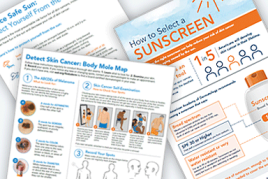
Sunscreens should be used every day that you will
be in the sun for more than 20 minutes.
American Academy of
Dermatology, Facts about Sunscreen |
|
|
|