







|
Treatment
Actinic keratoses (AKs) are so common
today that treatment for these lesions ranks as one of the most
frequent reasons that people consult a dermatologist.
Often patients want these lesions
removed for cosmetic purposes since AKs tend to occur in highly
visible places, such as the hands, arms, face, and neck. Whether or
not cosmetic concerns are a motivating factor, it is extremely
important to consult a dermatologist or dermatologic surgeon when an
actinic keratosis (AK) lesion is suspected. Left untreated, AKs have
the potential to progress to squamous cell carcinoma, a form of skin
cancer that can be life threatening.
Diagnosis
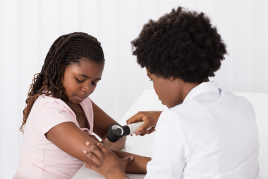
AKs have unique physical characteristics that allow dermatologists
to visually identify these lesions. However, if an AK is especially
large or thick, the lesion may be surgically removed for microscopic
examination (biopsy) to determine if squamous cell carcinoma is
present.
When an AK is diagnosed, dermatologists consider a number of factors
before choosing the most appropriate treatment method. Factors
include:
-
Size, number, location, and stage of
the lesions
-
Age, health, and medical history
-
Occupation
-
Cosmetic expectations and treatment
preferences
-
Patient compliance (i.e., willingness
to self-treat as needed for several weeks)
-
History of previous treatment
How AKs are Treated
There are several treatment options for AKs, including cryosurgery
(freezing), surgical excision, curettage (scraping) with or without
electrosurgery (heat generated by an electric current) and topical
(applied to the skin) medications. Lasers, chemical peels,
dermabrasion, and photodynamic therapy may also be used.
Patients who have multiple AKs may not have all lesions treated at
the same time, and in some cases, the dermatologist or dermatologic
surgeon will use more than one treatment option.
For information about specific treatments used to treat AKs, visit
Treatment
Options.
What to Expect After Treatment
Practice Sun Safety. Sun safety practices are a medical
necessity in order to prevent new AKs and squamous cell carcinoma
from developing. After treatment, patients routinely receive
guidelines for practicing sun safety.
Sun safety practices include:
-
Avoid excessive exposure to
sunlight. Stay out of direct sun exposure during peak (10a.m. —
4p.m.) sunlight hours.
-
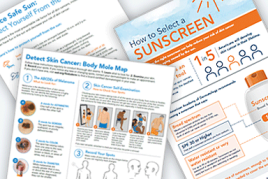
Use a broad-spectrum sunscreen with
a SPF of 15 or higher. Broad-spectrum sunscreen provides
protection from both the UVA and UVB rays of the sun. Apply
broad-spectrum sunscreen at least
15 to 30 minutes before going outdoors, even on cloudy days.
-
Reapply sunscreen every two hours.
When outdoors and even on cloudy days, be sure to reapply sunscreen
every two hours.
-
Wear protective clothing. When
outdoors during daylight, wear a wide-brimmed hat, sunglasses that
block 100% of the UV rays and tightly knit clothing that covers arms
and legs.
Topical Retinoids. In addition
to sun-protection practices, topical (applied to the skin) retinoids
(vitamin A derivatives) may be prescribed. Topical retinoids are not
suitable for every patient, but may be prescribed in some cases to
help prevent new AKs from developing.
Re-examination. Dermatologists and dermatologic surgeons
regularly
re-examine patients treated for AKs. Frequency depends on the extent
of the AKs, sun-damaged skin, and the treatment method.
Re-examination may be as frequent as every 8 to 12 weeks or require
only 1 to 2 visits per year. It is extremely important to keep these
re-examination appointments because when enough sun damage occurs to
cause AKs, the possibility of developing more AKs or even skin
cancer greatly increases.
Re-treatment. Re-treatment is sometimes necessary as new AKs
can develop and occasionally AKs recur. Whenever a lesion is
spotted, be sure to consult a dermatologist or dermatologic surgeon
because left untreated, AKs have the potential to progress to
squamous cell carcinoma.

An educational program brought to you by the American Academy of
Dermatology.
|
 |
|