









| |
Causes
of Aging Skin
Research shows that
there are, in fact, two distinct types of aging. Aging caused by the
genes we inherit is called intrinsic (internal) aging.
The other type of aging is known as extrinsic (external)
aging and is caused by environmental factors, such as exposure to
the sun’s rays.
Intrinsic Aging
Intrinsic aging, also known as the natural aging process, is a
continuous process that normally begins in our mid-20s. Within the
skin, collagen production slows, and elastin, the substance that
enables skin to snap back into place, has a bit less spring. Dead
skin cells do not shed as quickly and turnover of new skin cells may
decrease slightly. While these changes usually begin in our 20s, the
signs of intrinsic aging are typically not visible for decades. The
signs of intrinsic aging are:
-
Fine wrinkles
-
Thin and transparent skin
-
Loss of underlying fat, leading to hollowed cheeks and eye sockets
as well as noticeable loss of firmness on the hands and neck
-
Bones shrink away from the skin due to bone loss, which causes
sagging skin
-
Dry skin that may itch
-
Inability to sweat sufficiently to cool the skin
-
Graying hair that eventually turns white
-
Hair loss
-
Unwanted hair
-
Nail plate thins, the half moons disappear, and ridges develops
Genes control how
quickly the normal aging process unfolds. Some notice those first
gray hairs in their 20s; others do not see graying until their 40s.
People with Werner’s syndrome, a rare inherited condition that
rapidly accelerates the normal aging process, usually appear elderly
in their 30s. Their hair can gray and thin considerably in their
teens. Cataracts may appear in their 20s. The average life
expectancy for people with Werner’s syndrome is 46 years of age.
Extrinsic Aging
A number of extrinsic, or external, factors often act together with
the normal aging process to prematurely age our skin. Most premature
aging is caused by sun exposure. Other external factors that
prematurely age our skin are repetitive facial expressions, gravity,
sleeping positions, and smoking.
The Sun. Without protection from the sun’s rays, just a few
minutes of exposure each day over the years can cause noticeable
changes to the skin. Freckles, age spots, spider veins on the face,
rough and leathery skin, fine wrinkles that disappear when
stretched, loose skin, a blotchy complexion, actinic keratoses
(thick wart-like, rough, reddish patches of skin), and skin cancer
can all be traced to sun exposure.
“Photoaging” is the term dermatologists use to describe this type of
aging caused by exposure to the sun’s rays. The amount of photoaging
that develops depends on: 1) a person’s skin color and 2) their
history of long-term or intense sun exposure. People with fair skin
who have a history of sun exposure develop more signs of photoaging
than those with dark skin. In the darkest skin, the signs of
photoaging are usually limited to fine wrinkles and a mottled
complexion.
Photoaging occurs over a period of years. With repeated exposure to
the sun, the skin loses the ability to repair itself, and the damage
accumulates. Scientific studies have shown that repeated ultraviolet
(UV) exposure breaks down collagen and impairs the synthesis of new
collagen. The sun also attacks our elastin. Sun-weakened skin ceases
to spring back much earlier than skin protected from UV rays. Skin
also becomes loose, wrinkled, and leathery much earlier with
unprotected exposure to sunlight.
|
The deep
wrinkles, age spots, and leathery skin indicate premature
aging caused by years of unprotected exposure to the sun. |
 |
(Photo
used with permission of the American Academy of Dermatology
National Library of Dermatologic Teaching Slides)
|
People who live in sun-intense areas, such as Florida or Arizona,
can show signs of photoaging in their 20s. In fact, some people who
live in sun-intense areas develop actinic keratoses (AKs) and skin
cancer in their 20s.
While it may seem that the signs of photoaging appear overnight,
they actually lie invisible beneath the surface of the skin for
years. UV photography enables us to see the damage accumulating
beneath the surface of the skin years before the signs of photoaging
appear. Most people are surprised by the amount of photoaging that
the UV camera shows. To see actual patient photographs that show: 1)
what is visible to the naked eye and 2) what damage lies beneath the
surface, visit:
UV Photography Reveals Sun Damage
Facial Expressions. If you perform facial exercises to maintain a
youthful-looking appearance, it is time to stop. Repetitive facial
movements actually lead to fine lines and wrinkles. Each time we use
a facial muscle, a groove forms beneath the surface of the skin,
which is why we see lines form with each facial expression. As skin
ages and loses its elasticity, the skin stops springing back to its
line-free state, and these grooves become permanently etched on the
face as fine lines and wrinkles.
Gravity. Gravity constantly pulls on our bodies. Changes related to
gravity become more pronounced as we age. In our 50s, when the
skin’s elasticity declines dramatically, the effects of gravity
become evident. Gravity causes the tip of the nose to droop, the
ears to elongate, the eyelids to fall, jowls to form, and the upper
lip to disappear while the lower lip becomes more pronounced.
Sleeping Positions. Resting your face on the pillow in the same way
every night for years on end also leads to wrinkles. Called sleep
lines, these wrinkles eventually become etched on the surface of the
skin and no longer disappear when the head is not resting on the
pillow. Women, who tend to sleep on their sides, are most likely to
see these lines appear on their chin and cheeks. Men tend to notice
these lines on the forehead since they usually sleep with the face
pressed face down on the pillow. People who sleep on their backs do
not develop these wrinkles since their skin does not lie crumpled
against the pillow.
Smoking. Cigarette smoking causes biochemical changes in our bodies
that accelerate aging. Research shows that a person who smokes 10 or
more cigarettes a day for a minimum of 10 years is statistically
more likely to develop deeply wrinkled, leathery skin than a
nonsmoker. It also has been shown that people who smoke for a number
of years tend to develop an unhealthy yellowish hue to their
complexion. Additionally, a study conducted in 2002 showed that
facial wrinkling, while not yet visible, can be seen under a
microscope in smokers as young as 20.
These signs can be greatly diminished, and in some cases avoided, by
stopping smoking. Even people who have smoked for many years, or
smoked heavily at a younger age, show less facial wrinkling and
improved skin tone when they quit smoking.
For Healthier, Younger-Looking Skin
Prevention. While you cannot stop or even slow down the intrinsic
aging process, you can prevent signs of premature aging by
protecting your skin from the sun, quitting smoking, and eliminating
facial exercises.
Dermatologists recommend comprehensive sun protection to prevent
premature aging caused by the sun. Comprehensive sun protection
includes:
-
Avoiding deliberate tanning, including use of indoor tanning
devices.
-
Staying out of the sun between 10:00 a.m. and 4:00 p.m., when the
sun’s rays are the strongest.
-
Wearing protective clothing, such as a wide-brimmed hat and long
sleeves, when outdoors during the day.
-
Applying sunscreen year round. Sunscreen should be broad spectrum
(offers UVA and UVB protection) and have a Sun Protection Factor
(SPF) of 30 or higher. Sunscreen should be applied 20 minutes before
going outdoors to all skin that will be exposed. It should be
reapplied after sweating or being in water.
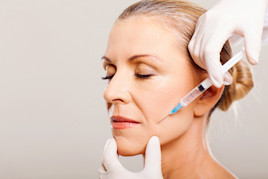
Treatment. If you are bothered by visible signs of aging, a number
of treatments are available. Injectable fillers and botulinum toxin
are suitable for people with busy lifestyles who do not want the
inconvenience of a long recovery. Radiofrequency is a procedure that
offers an alternative to the traditional facelift. Dermabrasion,
laser resurfacing, chemical peeling, microdermabrasion, and some
topical treatments can restore skin, giving it a smoother and
refreshed appearance.
Scientific research in the field of anti-aging continues to give
rise to new and promising treatment options. A dermatologist can
help you sort through the numerous options, including the myriad of
over-the-counter products. During a consultation, the dermatologist
will examine your skin, discuss your expectations, and recommend
suitable treatment options.
References:
American Academy of Dermatology. “Turning Back the Hands of Time.”
February 21, 2005.
Last accessed June 20, 2005.
Demierre MF et al. “Public knowledge, awareness, and perceptions of
the association between skin aging and smoking.” Journal of the
American Academy of Dermatology, 1999 Jul;41(1):27-30.
Fisher GJ. “The Pathophysiology of Photoaging of the Skin.” Cutis,
2005 Feb;75(2S):5-9.
Koh JS et al. “Cigarette smoking associated with premature facial
wrinkling: image analysis of facial skin replicas.” International
Journal of Dermatology, 2002 Jan;41(1)21-27.
Moschella S and Hurley H. (1992) “Aging and Its Effects on the
Skin.” Dermatology: Third Edition. Philadelphia: W.B. Saunders
Company.
Oikarinen A. “Aging of the skin connective tissue: how to measure
the biochemical and mechanical properties of aging dermis.”
Photodermatology, Photoimmunology and Photomedicine, 1994
Apr;10(2):47-52.

All content solely
developed by the American Academy of Dermatology
|
 |
 |
|
The sun accelerates aging of the skin.
Protecting your skin from the sun helps prevent premature aging. |
|
|
|