







| |
Cosmetic
Procedures
Chemical Peeling: What to Expect Before, During, and After
If you want to diminish fine lines and
wrinkles, skin discoloration, a dull complexion, or rough skin, your
dermatologist may recommend a cosmetic procedure called a chemical
peel. The following explains what happens before, during, and after
this procedure.
What to Expect Before a Chemical
Peel
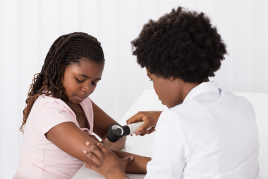
A consultation is essential. Your dermatologist will take a
complete medical history. Be sure to tell your dermatologist if you
are prone to cold sores, have had a cosmetic procedure in the past,
scar easily or have ever had a type of raised scar known as a keloid,
or took isotretinoin (a prescription medication used to treat severe
acne). These can have a tremendous effect on what you see after a
chemical peel.
After the consultation and a physical
exam that includes a close look at your skin, your dermatologist
will tell you if a chemical peel will help diminish the signs of
aging that concern you and if a chemical peel is right for you.
If a chemical peel is appropriate, one
of the following types of peels will be recommended:
|
Type of Peel |
What it Does |
May Contain |
Signs of Aging Treated |
|
Superficial — also known as the lunchtime peel |
Penetrates only the outer layer of skin to gently
exfoliate |
|
|
|
Medium |
Penetrates the outer layer of skin and reaches into the
middle layer of skin to remove damaged skin cells |
|
-
Age spots
-
Fine lines and wrinkles
-
Freckles
-
Moderate skin discoloration
-
Modest tightening for lax sun-damaged skin
-
Smooth rough skin
-
May remove some actinic keratoses
|
|
Deep |
Reaches deep into the
middle layer of skin to remove damaged skin cells |
|
Can make a person look years younger — removes fine to
moderate lines, age spots, freckles, shallow scars. Will
see brighter, smoother, slightly tighter, more youthful
skin. Can only be used on the face and only performed
once. |
Most medium and deep chemical peels
require pre-peel skin care. Usually prescribed for 2 to 4 weeks
before the peel, this skin-care plan helps the peel deliver the
best results and reduce potential side effects. The plan should
be carefully followed.
What to Expect During a Chemical
Peel
Superficial and medium-depth peels are performed in a
dermatologist’s office. A deep peel may be performed in a
dermatologist’s office or outpatient surgical center. General
(puts the patient to sleep) anesthesia and monitoring equipment
for the heart and lungs may be necessary for a deep peel.
Before applying the peel, the skin is prepped. Once the skin is
ready, the dermatologist quickly and evenly applies the peel. If
a deep peel is being performed, the skin will be treated one
small section at a time to limit effects on the heart and lungs.
Typically, a 20-minute interval between each application of the
peel solution is necessary with a deep peel.
As the peel works, the dermatologist watches the skin carefully
so that the peel can be stopped and removed at the appropriate
time. After the peel is removed, cool compresses may be applied
to help soothe the skin. These are usually not necessary for a
superficial peel.
A mild lotion or cream may be applied after a superficial or
medium-depth peel to help soothe the skin. After a deep peel,
surgical dressing will be used to protect the treated skin.
|
4 Tips for Better
Results After a Chemical Peel
-
Do not scratch or rub
the treated skin. While the skin may burn, itch, or
swell, it is important to resist the urge to scratch
or rub. Scratching and rubbing tend to diminish
results. To alleviate the discomfort, apply a cold
compress.
-
Keep your skin moist
and supple. This will give you better results. If
the skin dries out and cracks, scarring may occur.
-
Do not pick at scabs.
After a deep peel, the face tends to scab, but
picking at scabs can increase the risk of an
infection, skin discoloration, and scarring.
-
Wear sunscreen daily
once your skin heals. Applying sunscreen before your
makeup will help maintain the results.
|
What to Expect After a Chemical Peel
The chemical used in this cosmetic procedure causes the skin to
peel off. Over the next 1 to 14 days, new skin will appear.
All peels require some follow-up care. You will be given specific
instructions to follow, which will include everything from how to
wash your skin to sun protection. It is important to keep in mind
that sun exposure and smoking after a chemical peel can cause
unwanted side effects, including infection and scarring.
The following table shows what to expect after each type of peel.
|
Type
of Peel |
Healing Time |
At-home Care |
When
Wear Makeup |
Follow-up Visit |
|
Superficial |
1
- 7 days
Skin
will be red. After the redness disappears, scaling may
develop, which lasts 3 – 7 days. |
Lotion or cream applied until the skin heals, followed
by daily use of sunscreen |
Usually
immediately after the peel, but sometimes the next day |
No.
However, 3 to 5 light peels may be necessary, so you may
need to return once every 2 weeks for awhile to see
desired results.
|
|
Medium |
7 - 14
days
Skin
will be red and swollen. Swelling worsens for 48 hours.
Eyelids may swell. Blisters can form and break open.
Skin crusts and peels off in 7 – 14 days.
|
Daily soaks for a specified period
Apply ointment after each soak
Take an antiviral medication for 10 – 14 days
Apply mild lotion or cream
Total avoidance of the sun until skin heals |
5 – 7
days can wear camouflaging makeup |
Yes.
Follow-up visit required after the procedure. |
|
Deep |
14 – 21
days
Area
will be bandaged.
|
4 –
6 daily soaks while healing
Apply ointment after each soak for 14 days
After 14 days, apply thick moisturizer as directed
Take an antiviral medication for 10 – 14 days
Total sun avoidance for 3 – 6 months |
At
least 14 days before can apply makeup |
Yes.
The next day, the dermatologist will want to see you.
Several follow-up visits are required during the first
week. |
References:
Bernstein EF. “Chemical Peels.” In: Kaminer MS, Dover JS, Arndt KA,
editors. Atlas of Cosmetic Surgery. United States of America,
W. B. Saunders Company; 2002. p. 311-27.
Hirsch RJ. “Chemical Peels.” In: Sadick N, Lawrence N, Moy R et
al. Concise Manual of Dermatologic Surgery. China,
McGraw-Hill Companies; 2008. p. 31-6.
Monheit GD and Chastain MA. “Chemical and Mechanical Skin
Resurfacing.” In: Bolognia JL, Jorizzo JL, Rapini RP et al,
editors. Dermatology. 2nd edition. Spain, Mosby
Elsevier; 2008. p. 2313-27.

All content solely
developed by the American Academy of Dermatology
|
 |
|