







Unless someone invents time travel, you can’t
reverse the flow of time and become younger. However, with the wide
array of dermatologic treatments available today, you can remove
many of the effects of aging and photoaging. You can’t become
younger, but you can look younger and more attractive by working
with a dermatologist to choose the skin rejuvenation treatment that
is right for you.
This segment of AgingSkinNet provides a
description and discussion of the major treatments available today
for skin rejuvenation. Sometimes two types of treatment may be
combined to make each more effective.
Treatments discussed in this segment:
Dermatologic
Medical Skin Rejuvenation
Topically applied treatments are usually most
effective when skin manifestations of aging and photoaging are
superficial to moderate:
-
Tretinoin, a substance in the vitamin A
family, has been shown to reduce fine wrinkles, splotchy
pigmentation, and rough skin associated with chronic sun exposure.
Tretinoin cream 0.02% and 0.05% are the only prescription
treatments approved by the Food and Drug Administration (FDA) for
these indications. Other available forms of tretinoin are
indicated for the treatment of acne. Talk to your dermatologist
about which tretinoin formulation may be right for you.
-
Alpha-hydroxy acids (AHSs) may be used alone
or in combination with tretinoin to treat mildly damaged skin.
AHAs are derived from fruit and dairy products.
-
Over-the-counter products containing retinols
(of the vitamin A family), AHA, anti-oxidants and moisturizing
agents may temporarily improve the appearance of fine lines and
wrinkles.
-
Topical antioxidants, especially vitamins C
and E, function to help cells repair damage caused by ultraviolet
radiation and smoking.
|
 |
 |
|
Before |
After |
|
These untouched photographs show
this woman before and after six months of treatment with
tretinoin cream 0.05%. Her reduction in fine lines and
wrinkles is characteristic of a more dramatic improvement
experienced during clinical trials.
Individual results may vary.
|
Dermatologic
Surgical Skin Rejuvenation
Chemical Peeling
Chemical peeling,
also called chemexfoliation or dermapeeling, is a facial skin
rejuvenation procedure that does what its name implies—it peels the
skin. Its use is usually in the treatment of superficial to moderate
photoaging skin damage. Mild chemical peels can be applied to people
in their 20s, to prevent effects of aging from becoming apparent too
early in life.
In a chemical peeling treatment, a chemical
solution is applied to facial skin, causing the skin to blister and
peel off over a period of days. As the treated skin blisters and
peels, new skin forms to take its place. The new skin is usually
smoother and less wrinkled than the old skin.
A mild chemical peel is usually all that is
necessary to treat fine lines and wrinkles around the eyes and
mouth. Patients with minimal skin damage often respond best to a
series of light peels in combination with a skin care program
including retinoids and a sunscreen protection program. A
medium-depth peel is often more effective for patients with moderate
skin damage, including age spots, freckles and actinic keratoses. A medium-depth
peel may be combined with another treatment such as laser resurfacing to achieve
maximum effectiveness.
Depending on the objectives of the treatment as
determined jointly by the patient and dermatologist, the condition
and type of the patient’s skin, and the degree of skin damage, the
dermatologist by performing dermatologic surgery individualizes the
strength of the chemical solution and the depth of the peel. Peeling
solution may include one or more chemicals such as alpha-hydroxy
acids, trichloroacetic acid, or carbolic acid. The procedure can be
performed in the dermatologist’s office, or in an outpatient surgery
center. In addition to skin rejuvenation, chemical peeling is
effective in reduction of some acne scars. Peeling does not remove
deep scars.
The immediate after-effect of a chemical peel is
similar to a sunburn. After a mild or superficial peel, redness and
scaling of the skin last 3 to 5 days. Medium-depth or deep peeling
can result in redness, swelling, blistering and peeling for 7 to 14
days. Medications are prescribed to alleviate discomfort.
Overexposure to sun must be avoided for a period of time to prevent
sun damage while the new skin is susceptible to injury.
Chemical peeling is effective only for surface
skin damage. Effects of aging in deeper tissues, such as sagging
jowls and drooping eyelids, must be addressed by other procedures
that can be recommended by your dermatologic surgeon.
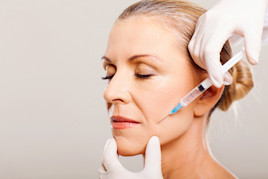
Soft-tissue
Augmentation
In
soft-tissue augmentation, a substance that is compatible
with the patient’s body tissues is injected under the skin to
elevate irregularities such as wrinkles, pits and scars. The
substances used for injection are primarily:
-
Collagen—a fibrous protein substance of all
human and animal tissue. It gives toughness and structure to skin,
bones, and ligaments. Most of the collagen used for soft-tissue
augmentation is derived from cattle. However, for people who are
allergic to bovine (cow-derived) collagen, collagen or
collagen-related substances may be self-donated by the patient or
obtained from a tissue donor. The dermatologist tests the patient
prior to collagen injection to determine if the patient is
allergic to bovine collagen. Collagen injection is usually given
in a series of treatments, until the desired effect of "filling
out" a wrinkle or depression is achieved. A local anesthetic
minimizes discomfort from the injection needle. The effects of
collagen injection may last for 3 to 12 months.
-
Self-donated body fat. Fat is harvested from
the patient’s own body and prepared for the procedure called
microlipoinjection. This fat-transfer procedure is sometimes
called "body sculpturing". The injected body fat is used to
replace fat lost from under the skin in the aging process. Defects
improved by microlipoinjection include creases around the nose,
mouth and chin, and the "drawn look" created by loss of fat pads
in the cheeks. The improvements in appearance vary between
patients. Some follow-up treatments may be necessary.
Microlipoinjection is performed in an outpatient clinic. An
after-effect of tissue swelling or bruising fades in a few hours
to a few days.
Botulinum Toxin
Dermatologists have harnessed the potent
biological effects of botulinum toxin
to dramatically improve effects of aging such as frown lines, crows
feet, and facial wrinkles. Botulinum toxin is the powerful agent of
botulism food poisoning, but botulism cannot be contracted from
cosmetic use of botulinum toxin. The toxin’s biological effects in
food poisoning are to block nerve impulses transmitted from the
brain to muscles, causing generalized paralysis including paralysis
of muscles used in breathing.
Dermatologists use purified botulinum toxin in
very tiny amounts to inject into a targeted facial muscle. The
resulting nerve blockade of that muscle causes a local
immobilization of muscle movement. This immobilization prevents
"crinkling" and "wrinkle" lines from forming when the patient frowns
or squints. Results of treatment last 3 to 4 months. To be maximally
effective, treatment with botulinum toxin is repeated over several
sessions and is combined with a program of muscle behavioral
training to minimize "wrinkling" facial expressions. Botulinum toxin
treatment may be used in combination with other procedures for
facial rejuvenation to achieve a more lasting effect. A botulinum
toxin treatment is accomplished in about 30 minutes in a
dermatologist’s office
Dermabrasion
Dermabrasion
is a treatment with many applications in dermatology and
dermatologic surgery, from removal or reduction of acne and chicken
pox scars to facial skin rejuvenation. The procedure, sometimes
called surgical skin planing, consists of planing off the surface
layer of skin with a rapidly rotating brush. The planing action
removes the skin surface, and a new layer of skin grows to replace
the skin removed. The principal after-effect is redness of the skin
similar to a severe sunburn; medications are prescribed to alleviate
discomfort. Healing usually is complete in about 10 days. Patients
must avoid sunlight for 3 to 6 months after treatment. A technique
that removes less surface skin is called microdermabrasion; it is
used most often for superficial skin defects and may be repeated at
intervals.
Each potential candidate for dermabrasion needs
thorough evaluation by a dermatologist to make certain that
dermabrasion is the correct procedure for that individual and that
the patient fully understands possible after-effects. For example,
pigmented skin may be permanently lightened in the area of
dermabrasion, and a person prone to form keloids after skin injury
could be at risk for scarring. Post-procedure treatments are
available to minimize most after-effects. Dermabrasion may be
combined with other procedures such as soft-tissue augmentation to
maximize effectiveness.
Laser Skin
Resurfacing
The use of lasers
in dermatology has advanced rapidly over the past 30 years. Today,
lasers have a broad range of dermatologic applications, including:
-
removal or improvement of wrinkles, lines and
other effects of aging and photoaging
-
treatment of superficial brown pigmented
lesions such as age spots, and deep pigmented lesions such as port
wine stains and birthmarks
-
removal or improvement of scars
-
removal of some skin cancers
-
removal or improvement of vascular moles
-
removal of tattoos
-
removal of warts
-
removal of unwanted hair
The principal applications of lasers in facial
skin rejuvenation are reduction or removal of wrinkles, lines and
age spots, to "resurface" the skin.
The laser (Light Amplification by
the Stimulated Emission of Radiation) is a
"light pump". It applies principles of radiation physics to
narrowly segregate light of selected wavelength and "pump" the light
radiation to high intensity. These beams of selected wavelength can
be varied in intensity and in the duration of emitted pulses.
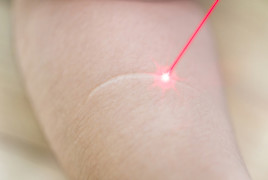
For example, powerful, rapid pulses of the
infrared-wavelength carbon dioxide laser can vaporize targeted skin.
The pulses of the carbon dioxide laser can be directed toward
resurfacing skin without bleeding. The benefits of laser skin
resurfacing include bloodlessness, plus:
-
reduced risk of infection
-
precisely controlled surgical effects
-
one-day outpatient treatment in many instances
After-effects and recovery times vary with
different laser procedures. A dermatologist will explain the risks,
after-effects and benefits of recommended procedures.
Lasers are powerful instruments and laser
surgery should be performed only by a dermatologist or dermatologic
surgeon with experience in the procedure. To learn more about lasers
and laser surgery, go to the Web site of the American Society for
Dermatologic Surgery.
Electrosurgical Resurfacing
An alternative to laser skin resurfacing is
electrosurgical resurfacing, also called "cold ablation." This
technique uses a micro-electrical radio frequency to deliver a pulse
of energy to the skin, removing or improving superficial to moderate
skin damage. The procedure has few after-effects, and recovery from
mild to moderate swelling is usually complete within a month.
Electrosurgical resurfacing offers the advantage of being applicable
to most skin types and colors, without loss of skin pigmentation.
Superfluous Hair Removal
Removal of superfluous hair may
contribute to overall improved appearance, with or without
concomitant facial skin rejuvenation. In women, especially, hair on
the chin, over the upper lip, or on arms and legs can create an
appearance of older age or masculinization. Traditional methods of
dealing with superfluous hair include: (1) bleaching with hydrogen
peroxide to make the hair less visible, (2) shaving to temporarily
remove hair, (3) plucking hairs, (4) coating the skin with wax, then
removing hair with the waxy coat, (5) using a chemical depilatory to
"dissolve" unwanted hair, and (6) electrolysis or electrothermolysis
to destroy hair follicles for relatively permanent hair removal.
Chemical depilation of facial skin may be
irritating and should be performed under the guidance of a
dermatologist with a depilating agent prescribed for individual
needs.
The safety and effectiveness of electrolysis or
electrothermolysis is dependent upon the training and skill of the
operator and the equipment used. In these methods a fine electrode
is inserted into each hair follicle to destroy the cells from which
new hair could grow.
Laser hair removal has been proven effective in
recent studies. Hair loss for two or more years has been documented,
and may well prove to be long-term or permanent as patients are
followed up for longer periods of time. Laser hair removal in most
current use is accomplished by photothermolysis—using a laser to
generate heat in hair follicles and render them incapable of growing
new hair. Skin color and hair color are among factors that a
dermatologist considers in determining the type of laser to use,
duration of treatment, and number of treatments that may be
necessary to accomplish desired results. Side effects of laser hair
removal include post-treatment pain for a few hours to a few days,
and skin redness. The treating dermatologist can prescribe medicines
to alleviate the side effects. Laser hair removal is a procedure
that should be performed only by a dermatologist experienced in the
use of lasers.
Non-ablative Skin Treatments
Liposuction
Wrinkles, crease lines and age spots are visible
effects of aging, and unwanted fat deposits are another. Despite
diet and exercise undertaken to keep looking young and trim, fatty
deposits may remain on the face, chin, neck, breast, abdomen, hips,
thighs, buttocks, knees and ankles. A dermatologist experienced in
the procedure can use tumescent
liposuction to remove these localized fat deposits. Tumescent
liposuction is performed only after a full medical evaluation.
This dermatologic surgery is performed in an
outpatient setting, usually under local anesthesia and anti-bleeding
medication. In some cases, ultrasound is used to break down and
liquify fat cells in the area to be treated. Fat is removed from the
targeted area with a vacuum inserted through an incision in the
skin. Many patients do not require postoperative pain medication. It
is usually possible for the patient to resume physical exercise 3 to
7 days after the procedure. Liposuction is not a substitute for
diet, exercise or weight reduction. It complements other efforts to
keep a young and trim look. Go to the Web site for the American
Society for Dermatologic Surgery for more information about
liposuction.
Surgical Excision
Sometimes facial skin
rejuvenation cannot be accomplished to the patient’s satisfaction by
removal of surface defects. Long-term effects of gravity may affect
deeper layers of tissue, with resulting sags in eyelids, forehead,
cheeks, shin, and areas around the mouth. In these instances, a
dermatologic surgeon should be consulted regarding the possibility
of surgical procedures:
-
blepharoplasty (eyelid surgery) to correct "droopy" eyelids by
removing excess fat pads and skin
-
brow lift to reduce severs lines in the
forehead and raise the eyebrows
-
rhytidectomy (fact lift) to tighten and trim excess skin on
cheeks, chin, neck, and around the mouth

An educational program brought to you by the American Academy of
Dermatology.