






| |
Cosmetic
Procedures
Laser Skin Rejuvenation: What to Expect Before, During, and After
Lasers are used to treat a number of aging-skin
concerns. The following explains what happens before, during, and
after laser skin rejuvenation.
What to Expect Before Laser Skin Rejuvenation
While people of any age who are in good health may be a
candidate for laser skin rejuvenation, a consultation is essential
before the procedure. During this consultation, a dermatologist will
gather your medical history. Be sure to tell your dermatologist if
you have:
-
Had unusual or prolonged wound healing
-
Any blood-clotting problems
-
A tendency to scar (keloid or raised scar)
-
An infectious disease such as hepatitis or
HIV
-
Had a cosmetic procedure, especially a
filler, surgical facelift, or eyelid lift
-
Taken isotretinoin (a medication used to
treat severe acne)
These will not necessarily preclude laser skin
rejuvenation but may affect how the dermatologist proceeds.
During the consultation, your dermatologist will closely examine
your skin. The success of any cosmetic procedure depends on
effectively diagnosing what is causing the aging-skin concern and
knowing how deeply the concern penetrates the skin.
If laser skin rejuvenation will diminish the signs of aging that
concern you and is appropriate for you, your dermatologist will tell
you what can be expected, the number of treatments needed, and
potential side effects.
Between the consultation and the procedure, it is important to
protect your skin from the sun and not tan. Lasers skin rejuvenation
is not performed on skin that is tan or sunburned.
If deep resurfacing is recommended, you will be given a skin care
plan to follow before the procedure. Your dermatologist may
prescribe a variety of topical (applied to the skin) and/or oral
medications. What is prescribed depends on the type of laser to be
used and the signs of aging to be treated.
What to Expect During Laser Skin Rejuvenation
While what happens during this procedure varies greatly with the
type of laser or light therapy used, there are some similarities.
These procedures are generally performed in a room set up
specifically for laser or light therapy. Before the procedure, the
skin is cleansed to remove oils and makeup. The patient is given eye
protection, and topical anesthesia may be given.
If photodynamic therapy (PDT) will be performed, a substance that
makes the skin more sensitive to light, a photosensitizer, will be
applied and left on the skin for 30 minutes or longer.
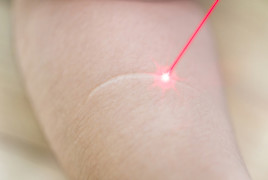
The actual procedure involves the dermatologist using a wand-like
laser or other handheld device that emits light. As the device is
fired, it releases energy. Some people say this feels as if a rubber
band is being snapped against the skin. After the treatment, ice
packs may be applied to reduce the swelling and discomfort.
|
 |
This 68-year-old woman did not
like the deep lines around her mouth. |
|
|
|
|
 |
Two months after undergoing an
ablative laser procedure |
|
(Photos used with permission of the
American Academy of Dermatology National Library of Dermatologic
Teaching Slides) |
What to Expect After Laser Skin
Rejuvenation
What you see after the procedure depends on the type of laser or
other light therapy used. After a procedure with a non-ablative
laser or IPL, you will not have a visible wound. But the treated
skin will likely be red and puffy. These effects last a few
hours and can be covered up with makeup. There is generally no
downtime.
After photodynamic therapy (PDT) or treatment with a fractional
laser, the downtime is generally 1 to 3 days. Before leaving
your dermatologist’s office, you will be given post-treatment
instructions. After PDT, emphasis will be placed on how to
protect your skin from the sun and other bright light. Sun
exposure after PDT can be very painful and result in a severe
sunburn and blistering.
Downtime ranging from 3 days to 3 weeks is necessary after an
ablative laser procedure because your skin will have a visible
wound. While this wound will heal quickly, redness can last for
1 to 4 months — or even longer after some laser treatments. For
about 1 year, you may experience visible flushing whenever you
exert yourself.
At-home care following an ablative laser procedure includes
wound care. For a specified number of days, you will need to use
soaks and apply ointment. You may need to take an antibiotic and
an antiviral to help prevent infection.
It is important to follow all instructions given after the
procedure. Not following your dermatologist’s instructions
regarding sun protection and wound care can cause side effects.
These include scarring, long-lasting redness, and the appearance
of spider veins. Following your dermatologist’s instructions
also will help you see the best possible results.
References:
Alexiades-Armenakas MR, Dover JS, Arndt KA. “Laser Therapy.”
In: Bolognia JL, Jorizzo JL, Rapini RP et al, editors.
Dermatology. 2nd edition. Spain, Mosby Elsevier;
2008. p. 2099, 2111-6.
Tope WD and Bhardwaj SS. “Photodynamic Therapy.”
In: Bolognia JL, Jorizzo JL, Rapini RP et al, editors.
Dermatology. 2nd edition. Spain, Mosby Elsevier;
2008. p. 2083-5.

All content solely
developed by the American Academy of Dermatology
|
 |
|