











Getting a tattoo often seems like a good idea at the
time—especially when you are young. In later years the tattoo may
not seem to have been such a good idea. A tattoo that "made a
statement" in one’s youth can be an embarrassment as one matures,
becomes employed, gets married, etc.
Dermatologists can
offer a number of methods of tattoo removal. The choice of method
depends on such factors as (1) the location of the tattoo on the
face or body, (2) the depth of tattoo pigment in the skin and the
extent to which it has migrated from the site of deposition, (3) the
cost of the procedure, and (4) the outcome desired by the patient.
Professionally applied
tattoos are usually easier to remove than those done by an amateur
because the tattoo pigment tends to be more evenly distributed under
the skin. Tattoos by amateurs are frequently done by depositing
India ink under the skin with a needle, at varying depths under the
skin and at varying concentrations. Black and blue tattoos are the
easiest to remove; green and yellow are the hardest.
The older the tattoo,
the more likely it is that pigment will have migrated widely and
deeply under the skin. Thus, some "old" tattoos may not be
completely removable by any means other than wide and deep surgical
excision. If surgery is agreed upon as the best treatment, patient
and physician should discuss the probable extent of the surgical
scar and how the scar can be minimized.
Other methods of tattoo
removal include:
Salabrasion—Salt
is used as an abrasive to peel away the tattoo surface and
underlying layers. Several salabrasion treatments may be required.
The salabrasion procedure can cause substantial discomfort for some
patients and it cannot remove pigment in deeper layers of skin.
Local anesthetic is administered to minimize discomfort. Healing
requires several days.
Dermabrasion—A
rapidly rotating brush is used to remove pigmented skin. Dermabrasion can often remove all pigment in a
professionally-applied tattoo, but if pigment has migrated or been
deposited in deep subcutaneous fat, complete removal by dermabrasion
may not be possible. Surgical excision is the only way to remove all
pigment when subcutaneous fat is involved. Local anesthetic is
usually administered to minimize discomfort. Healing may require
several days.
Chemical Peeling
– Application of this acid to the skin can remove tattoos in a
cost-effective method but may leave a small scar. Consult with your
dermatologist to determine the best result in partial or total
treatment with peeling agents.
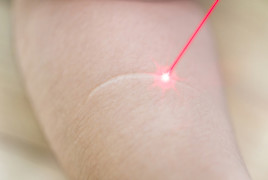
Laser removal—Removal
of tattoo pigment can be done with infrared lasers or color-specific
lasers. Color-specific lasers such as the Q-switched ruby laser and
alexandrite laser, and the infrared Nd:YAG and carbon dioxide
lasers, have proven very effective in removing tattoos. Multiple
treatments are usually necessary, especially when tattoos are
multi-colored. Black tattoo pigment absorbs all laser wavelengths,
making it the easiest to treat. Other colors, such as green,
selectively absorb laser light. These colors can only be treated by
selected lasers based upon the pigment color. Similar to
dermabrasion, results are influenced by the depth of pigment in the
skin and other factors. Local anesthesia is usually given to
minimize discomfort. The treated area is a burn that heals over a
number of days. Infrared lasers such as carbon dioxide (CO2)
and Nd:YAG are especially effective in removing large, superficial
tattoos with minimal subsequent scarring. The powerful infrared
laser beam can vaporize and remove pigmented tissue.
-
Color-specific
lasers remove tattoos by color-specific absorption of laser
energy by pigments in the tattoo. Destruction is limited to
pigments of the same color (wavelength) of the laser beam, and at
tissue depths were the laser beam can penetrate. It may be
necessary to use several color-specific laser beams over several
subsequent treatments to remove pigment from a multi-colored
tattoo. Q-switching technology that delivers short, powerful laser
pulses has improved the effectiveness of color-specific lasers in
tattoo removal.
The most common
complications of tattoo removal are scarring, and residual pigment
under the skin. It is helpful for a patient to know that tattoo
removal almost always results in a scar of some kind. The patient
and dermatologist should discuss the probability of scarring, and
post-procedure treatment for scarring. In some instances a choice
must be made between a more extensive procedure to remove all
pigment, and a less extensive procedure that may leave pigment in
deep tissues.