







If you are considering a cosmetic procedure to
diminish the appearance of spider or varicose veins, your
dermatologist may recommend one of the following:
-
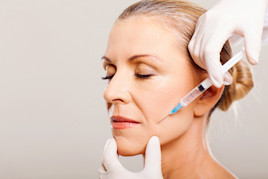
Sclerotherapy - A solution that seals
off the vein is injected with a very fine needle.
-
Ambulatory phlebectomy - The vein is
surgically removed one small section at a time via
micro-incisions.
-
Laser therapy or radiofrequency -
Energy from the laser or radiofrequency device closes the vein.
What to Expect Before Vein Treatment
A physical examination and complete medical history are
necessary to determine which treatment will provide the patient with
the best results. Sometimes the dermatologist needs to see how the
blood is flowing within a vein, and the patient undergoes a
non-invasive imaging scan such as a Doppler ultrasound. The
dermatologist considers all of this information before recommending
treatment.
What to Expect During Vein Treatment
If your dermatologist recommends one or more of these
procedures, this is what you can expect:
Sclerotherapy – The most widely used procedure, doctors have
been treating unwanted veins with sclerotherapy for more than 100
years.
When a patient undergoes sclerotherapy, a solution is inserted into
the vein with a very fine needle. This solution causes the walls of
the vein to thicken and stick together. The vein will begin to seal
shut. Eventually, the closed vein is eliminated by the body.
After the injections, the treated area is dressed and the patient is
asked to walk around the office. If a leg has been treated, the leg
is wrapped in a compression bandage or a compression stocking is
placed on the leg before the patient stands up.
The patient may be asked to wait in the office for 15 to 30 minutes
before leaving so that the dermatologist can evaluate the results.
More than one office visit may be needed to treat the veins.
Ambulatory phlebectomy – Used to treat a wide variety of
veins, ambulatory phlebectomy is commonly the best option for
younger patients with varicose veins. The walls of their veins are
usually too thick and strong for sclerotherapy to be effective.
Ambulatory phlebectomy also is commonly used to treat varicose veins
on the trunk of the body.
This procedure begins with the patient standing so that the
dermatologist can outline the vein(s) to be treated with a special
pen. The patient then lies down, and the dermatologist re-inspects
the vein(s). Once the dermatologist has marked all the areas, the
patient is given a type of anesthesia called tumescent anesthesia,
which causes the area to swell. This anesthesia can cause temporary
loss of sensation in the leg for up to 10 hours.
|
 |
 |
|
Legs veins marked before an
ambulatory phlebectomy |
2 years
after the ambulatory phlebectomy |
|
(Photos used with permission of the
American Academy of Dermatology National Library of Dermatologic
Teaching Slides) |
Once the anesthesia has taken effect, the
dermatologist makes a series of micro-incisions. Special
surgical instruments are then inserted so that the vein can be
gently lifted and loosened until it easily slides out. Stitches
are generally not needed unless a large vein is removed.
After removing the vein, the treated area is dressed to prevent
infection. A compression bandage or compression stocking is
applied before the patient is asked to stand. The entire
procedure takes 30 to 60 minutes.
Once standing, the patient is asked to walk around the office
for about 10 minutes. If the patient looks well upon
re-examination, the patient often can leave.
Laser treatment and radiofrequency – These newer
treatment options offer some patients an alternative to a
traditional surgical procedure called vein stripping and
ligation, which must be performed in a hospital. Radiofrequency
can be used to treat larger leg veins. Lasers are suitable for
treating some larger leg veins, very fine spider veins, veins in
the foot or ankle, and spider veins that can appear after
sclerotherapy.
When used to treat a larger leg vein, the procedures are
similar. The skin is anesthetized and a small incision is made
so that either a radiofrequency catheter or laser fiber can be
inserted into the vein. As the catheter or fiber is withdrawn,
energy is emitted that causes the vein to collapse and seal
shut.
After the procedure, the area is dressed to prevent infection, a
compression stocking or bandage is applied, and the patient is
asked to walk. Both procedures can be performed in less than 1
hour.
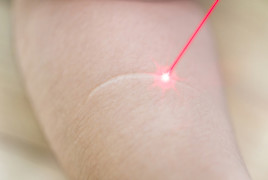
When used to treat spider veins, a laser fiber is not inserted.
Instead, the laser beam is directed at the spider vein. A few
treatment sessions are generally needed to diminish spider
veins. Each session lasts about 10 to 15 minutes, and a session
can be repeated every 1 to 2 months.
What to Expect After Vein Treatment
While most patients can return to work the day after one of
these procedures, some at-home care is required. The dressing on
the treated area must be changed as instructed.
When a leg is treated, a compression stocking or bandage may be
prescribed to ensure the best possible cosmetic results. A
compression stocking or an elastic bandage may be prescribed for
7 to 21 days — and sometimes longer.
Walking is essential part of recovery when a leg is treated.
Walking helps prevent potential side effects. Your dermatologist
will tell you how often to walk and for how long. Strenuous
physical exercise such as weight training should not be resumed
until the dermatologist says it is okay.
After each laser therapy session, it is important to protect the
treated area from sun exposure for 14 days. Sun exposure can
cause dark spots on the skin.
References:
Goldman MP, Weiss RA, and Sadick NS. “Sclerotherapy and Ambulatory
Phlebectomy.” In: Bolognia JL, Jorizzo JL, Rapini RP et al,
editors. Dermatology. 2nd edition. Spain, Mosby
Elsevier; 2008. p. 2329-43.
Weiss
RA and Dover JS. “Leg Vein Management: Sclerotherapy, Ambulatory
Phlebectomy, and Laser Surgery.” In: Kaminer MS, Dover JS, Arndt KA,
editors. Atlas of Cosmetic Surgery. United States of America,
W. B. Saunders Company; 2002. p. 407-31.

All content solely
developed by the American Academy of Dermatology

Supported by an educational donation
provided by The Allergan Foundation.