







| |
EczemaNet Article
Proper
Treatment Helps Ease Burden of Eczema
When a child develops eczema (atopic
dermatitis), parents often feel helpless. The patches of dry,
inflamed, and intensely itchy skin can be uncomfortable — and even
painful.
And the effects can be more than skin deep. If your child is in
school, visible patches can cause other kids to bully and tease.
Eczema also can make it difficult to concentrate at school. The
intense itch can make it impossible to pay attention in class.
It can be difficult for parents to know what to do to help ease a
child’s discomfort. There is so much conflicting information
available. The following facts can help you make an informed
decision.
Eczema must be managed; it cannot be cured.
It is easy to find products that guarantee to cure eczema in just a
few weeks. These claims give parents false hope. The truth is eczema
cannot be cured, but most cases can be controlled with proper
treatment.
Dermatologists recommend early treatment for eczema.
Eczema can be a chronic (long-lasting) condition. Receiving proper
treatment early helps prevent the disease from becoming worse. The
more severe eczema becomes, the more difficult it is to manage.
The medicines that dermatologists prescribe are safe when used as
directed.
This fact is often difficult for parents to believe. The information
that comes with topical (applied to the skin) medicine prescribed
for eczema contains warnings that can be frightening.
The American Academy of Dermatology (Academy) believes these
warnings confuse and unnecessarily worry people. There is no data to
prove that with proper use, topical (applied to the skin)
pimecrolimus and tacrolimus are dangerous. The data come from using
these medicines in pill form. When applied to the skin, virtually
none of the medicine gets inside the body. The Academy believes that
these are valuable medicines. When used properly, they significantly
reduce the debilitating impact of eczema and allow millions of
people to live normal lives.
Nonetheless, these warnings can be frightening. This often leads
parents to avoid these medicines or use them too sparingly. Either
approach often allows eczema to get worse. Then more costly and
aggressive medicine is usually needed.
Using the medicines as prescribed helps to control eczema and keep
it from progressing. Dermatologists have the knowledge needed to use
these medicines safely.
Alternative therapies are not a substitute for proven medical
treatment.
A completely safe, all-natural treatment that eliminates eczema
certainly sounds wonderful. If such a therapy existed, your
dermatologist would tell you. The truth is that there are thousands
of alternative treatments. This suggests that nothing works well.
If you want to try alternative medicines, dermatologists caution
that you:
-
Consult a dermatologist and not
forgo the recommended medical treatment. Delaying conventional
medical treatment puts a child at risk for developing more
severe eczema.
-
Tell your dermatologist about any
alternative therapy that you use. Some can cause dangerous
interactions when used with conventional medicine.
Proper treatment can be
time-consuming and messy.
A treatment plan prescribed by your dermatologist can be
time-consuming. Keeping eczema under control requires daily care.
All the fuss and mess can be unpleasant for a child, especially in
the beginning. After a particularly tiring day, many parents wonder
if all the fuss is worth it.
Research shows that sticking with the plan significantly improves a
child’s outcome. It also can reduce the need for medication over
time.
A written action plan can help.
Treatment can vary from day to day. If the skin looks good, you may
just need to bathe the child and moisturize the skin twice that day.
A moderate flare-up requires a different approach. Asking your
dermatologist to provide you with a one-page written action plan can
help alleviate any confusion.
Trust Your Dermatologist
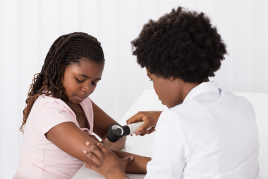
By seeing a dermatologist, you can help control your child’s eczema.
This can bring relief that is more than skin deep.
More Information
Moisturizing and Cleansing Key to Treating Atopic Dermatitis
Safe and Effective Eczema Medications for Young Children
Bleach Baths May Help Control Atopic Dermatitis
References:
American Academy of Dermatology. “Alternative Therapies for
Fighting Eczema Hold Promise, But Dermatologists Caution They Are No
Substitute for Proven Medical Treatments.” News release issued July
29, 2009. Available at:
www.aad.org/media/background/news/Releases/
Alternative_Therapies_for_Fighting_Eczema_Hold_Pro/
Last accessed December 17, 2009.
American Academy of Dermatology. “American Academy of
Dermatology Issues Statement in Response to FDA Decision Related to
Two Eczema Medications.” News
release issued March 10, 2005.
Available at:
www.aad.org/media/background/news/Releases/
American_Academy_of_Dermatology_Issues_Statement_I2/
Last accessed December 17, 2009.
Chisolm SS, Taylor SL, Balkrishnan R et al. “Written action
plans: potential for improving outcomes in children with atopic
dermatitis.” Journal of the American Academy of Dermatology.
October 2008; 59: 677-83.

All content solely
developed by the American Academy of Dermatology |
 |
 |
|
In this article, the word “eczema” refers only to atopic
dermatitis, a type of eczema that usually begins before
age 5. |
|
|
|