








|
Laser
Treatment for Psoriasis
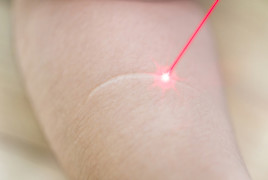
Lasers offer a unique treatment option
called “targeted phototherapy.” This means that the light from the
laser can target the psoriasis and not touch the surrounding skin.
Because the light treats only the psoriasis, a strong dose of light
can be used. This strong dose can penetrate deeper into the
psoriasis. This offers many people an effective way to treat a
stubborn patch of psoriasis, such as can develop on the scalp, feet,
or hands.
|
 |
 |
 |
 |
After 4
treatments with a pulsed dye laser, this 14 year-old
girl had 95% clearance of stubborn psoriasis on her
hands and feet. The psoriasis had been there for 6
years.
Photographs used with
permission of the Journal of the American Academy of
Dermatology.
All photographs were published in the Journal of the
American Academy of Dermatology, Vol. # 54, de Leeuw
J, Tank B, Bjerring PJ, et al, “Concomitant
treatment of psoriasis of the hands and feet with pulsed
dye laser and topical calcipotriol, salicylic acid, or
both: A prospective open study in 41 patients,” 266-71.
Copyright Elsevier (2006). |
Number of treatments: This
type of phototherapy requires fewer treatment sessions than
other types of phototherapy. If the psoriasis responds to laser
treatment, between 4 and 10 treatment sessions typically clear
the targeted psoriasis. This will vary with the type of laser
and the psoriasis.
How long clearing lasts: This is a newer treatment
option, so there is limited information about how long remission
lasts. In one study, the pulsed dye laser was used to treat
psoriasis on the hands and feet. To help the laser light
penetrate the psoriasis, patients also applied a topical
(applied to the skin) psoriasis medicine between laser
treatments. Those who had a good or very good response (76%)
also saw clear skin for quite some time. The average remission
time was 11 months.
More studies have been conducted with the excimer laser. One
study found that the average remission time is 3 to 4 months
after the last treatment. Another study suggests that longer
remission is possible. This study found that after 1 year, most
(26 of 28) patients were still in remission.
Side effects: Treatment with a pulsed dye laser will
cause bruising, and this is expected. A pulsed dye laser
actually penetrates the skin and destroys the blood vessels that
allow the psoriasis to form. Because this laser produces visible
light (not UV light), the pulsed dye laser does not increase the
risk of skin aging or skin cancer.
Other possible side effects from laser treatment (pulsed dye and
excimer) are temporary redness, swelling, and a burning
sensation after treatment. In a few people, blisters or burns
develop. Some see darkening of the treated skin. There also is a
small risk of scarring.
If you are considering laser treatment
People considering laser treatment should know that many
states do not regulate who can perform a procedure with a laser
or other light source. Since lasers and other light treatments
carry potential side effects, always ask who will perform the
procedure. The American Academy of Dermatology recommends that
laser procedures be performed by a board-certified dermatologist
or under this doctor’s direct supervision.
It also is important to know that while laser treatment can
effectively treat a small area of psoriasis, it cannot treat
widespread psoriasis.
References:
American Academy of Dermatology.
“American
Academy of Dermatology Issues New Guidelines for the Management
of Psoriasis With Ultraviolet Light Therapy.” News release
issued October 22, 2009. Available at
www.aad.org/media/background/news/
Releases/American_Academy_of_Dermatology_Issues_New_Guideli4/.
Last accessed January 25, 2010.
de Leeuw J, Tank B,
Bjerring PJ et al. “Concomitant treatment of psoriasis of
the hands and feet with pulsed dye laser and topical
calcipotriol, salicylic acid, or both: a prospective open study
in 41 patients.” Journal of the American Academy of
Dermatology February 2006; 54: 266-71.
Menter A, Korman NJ,
Elmets CA et al. “Guidelines of care for the management
of psoriasis and psoriatic arthritis: Section 5. Guidelines of
care for the treatment of psoriasis with phototherapy and
photochemotherapy.” Journal of the American Academy of
Dermatology January 2010; 62: 114-35.
Morison WL, Atkinson DF,
Werthman L. “Effective treatment of scalp psoriasis using the
excimer (308 nm) laser.” Photodermatology Photoimmunology &
Photomedicine August 2006; 22: 181-3.

All content solely
developed by the American Academy of Dermatology
For an overview, visit
the AAD pamphlet
Psoriasis and Psoriatic Arthritis.
|
 |
|
What
Dermatologists Tell Their Patients |
|
While laser treatment
clears some psoriasis, no one treatment works for
everyone. Treatment must be tailored to the patient's
individual needs. |
|
|
|