








|
PsoriasisNet Article
Lasers:
A Scientific Explanation
In recent years, science began to bring
the ultraviolet laser into use in treatment of psoriasis.
Lasers that emit light in wavelengths
from ultraviolet to infrared have wide use in dermatology. Their use
in treatment of psoriasis is very specific within the spectrum of
ultraviolet radiation.
Lasers: What They Are
The word LASER is an acronym: Light Amplified by
Stimulated Emission of Radiation. In the
simplest terms, stimulated emission is a principle of optical
physics that amplifies light (or other electromagnetic radiation) by
(1) segregating light of a single wavelength or very narrow band of
wavelengths, and (2) "pumping" the light to high intensity.
The first laser was developed in 1960
using a ruby to segregate visible light in a narrow red wavelength.
Since then lasers have been developed across the electromagnetic
spectrum from very short ultraviolet to long infrared wavelengths,
using a variety of substances to separate radiation of the selected
wavelength. These substances include gases (carbon dioxide, argon,
etc.), metals and metal vapors (copper), crystals (ruby,
alexandrite, etc.), and dyes.
The atoms or molecules of the
substances that separate selected wavelengths of radiation are said
to be excitable. When "pumped" by an electrical, chemical or
optical energy source, they become pumped-up. Then, when hit by one
unit of radiation (a photon) each excited atom or molecule is
stimulated to emit another identical photon. Mirrors are used to
bounce the photons back and forth, stimulating emission of more
photons with each pass. At a given point in the process, the highly
selected, extremely bright, monochromatic (single wavelength)
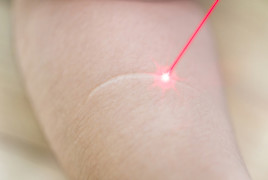
radiation is allowed to emit from the laser as a coherent beam. The
beam is highly controllable, allowing precise direction of radiation
energy into a target area. The beam exceeds the intensity of any
natural radiation source.
Electromagnetic wavelengths are
measured in fractions of a meter. The wavelengths of lasers used in
dermatology range from long infrared (10,600 micrometers - millionths
of a meter) to short ultraviolet (193 nanometers - billionths of a
meter). As new lasers are developed, the list of instruments and
wavelength applications will grow.
Photochemical Interactions
Photochemical interactions are the interactions principally
involved in the phototherapy of psoriasis. Ultraviolet (UV) light
induces biologic reactions in skin cells that can result in clearing
of psoriatic lesions. The UV radiation of sunlight contains all
ultraviolet wavelengths. Phototherapy investigators have shown that
UV wavelengths from 300 to 313 nanometers (nm) are most effective in
clearing psoriasis. UV lamps used in phototherapy are selective in
this narrow band of wavelengths.
Excimer lasers in the 300 nm to 313 nm
spectrum are now being used and/or investigated in the treatment of
psoriasis. An advantage of the UV laser over a UV lamp is the
ability to put the coherent laser beam on a very restricted
area - e.g., elbow or knee - avoiding UV exposure of larger areas of
skin. It is likely that these lasers will be of benefit in helping
to clear small, localized plaques of psoriasis, resistant to
traditional therapy. Since the use of lasers in the treatment of
psoriasis is a new treatment, information on effectiveness and side
effects is still being collected.
Some Terminology
This laser terminology is helpful in understanding laser
applications:
-
Continuous wave laser beam:
Laser light emitted in an uninterrupted beam.
-
Excimer laser:
Excimer is a compound word describing an excited dimer laser. A
dimer is a compound formed by two identical molecules; the excited
dimer is "pumped" by an energy source to become excited to emit
photons of a selected wavelength.
-
Photon:
A unit of light. A photon has the unique ability to behave as a
particle and as a wave. Although it is identified as a particle, its
energy level is defined as wavelength.
References:
AAD Dermatology Insight, Spring 2000,
P. 4
Asawanonda P, Anderson RR, Chang Y,
Taylor CR. 308 nm excimer laser for the treatment of psoriasis: a
dose-response study. Arch Dermatol 2000; 136:619-624.

All content solely
developed by the American Academy of Dermatology
For an overview, visit
the AAD pamphlet
Psoriasis and Psoriatic Arthritis. |