








|
PsoriasisNet Spotlight Article
Treatment: Scalp Psoriasis
Yes, scalp psoriasis can be
controlled.
There are many
treatments for scalp psoriasis. Some people get relief from a
medicated shampoo or solution that can be purchased without a
prescription. But scalp psoriasis can be stubborn. Many people see a
dermatologist for treatment.
Diagnosis: The First Step in Successfully Treating Scalp
Psoriasis
Before prescribing treatment for scalp psoriasis, a dermatologist
will examine your scalp. Usually a dermatologist will simply look at
the scalp and make the diagnosis.
Sometimes scalp psoriasis can look like another skin condition, and
a dermatologist will remove a bit of skin and send the skin to a
lab. The lab report will tell the dermatologist whether the
condition is scalp psoriasis. Your dermatologist may refer to this process as
a biopsy. A dermatologist can safely and quickly perform a biopsy in
the office.
Scalp Psoriasis Treatments
The treatments that dermatologists prescribe for their patients who
have scalp psoriasis can be divided into these categories:
-
Medication
applied to the scalp. This is the most commonly prescribed
treatment for scalp psoriasis. Your dermatologist may call it a
“topical.” These medications include:
A corticosteroid
that can be applied to the scalp is the mainstay treatment for
scalp psoriasis.
Studies show that a corticosteroid is more effective than any
other treatment that you can apply to the scalp. It is
prescribed for a short period of time and works quickly to clear
the scalp.
Topical corticosteroids are safe when used as directed. Because
side effects can occur with long-term use, other medications may
be used to keep the scalp clear. These medications include
calcipotriol/calcipotriene and tazarotene.
|
Treatment Tip: When
applying the medication, be sure to lift your hair away
from the scalp so that you can apply the medication
directly to your scalp. |
-
Medicated shampoos. A
shampoo may be part of your treatment plan. For people who
have moderate to severe psoriasis on their scalp, a
dermatologist may prescribe a psoriasis shampoo that
contains clobetasol propionate. While clobetasol propionate
is a strong corticosteroid, studies show that when used in a
shampoo, it can provide safe and effective treatment for
scalp psoriasis.
In studies, patients have been able to use a psoriasis
shampoo containing clobetasol propionate daily for as long
as 4 weeks. If the scalp responds, the shampoo can be used
once or twice a week to maintain the results.
|
Treatment Tip: When
shampooing, be gentle. Rubbing, scrubbing, and
scratching your scalp tends to make scalp psoriasis
worse. |
-
Scale softeners.
Psoriasis can be thick, which makes it difficult for topical
(applied to the scalp) treatment to work. Applying a scale
softener to the psoriasis can help. A product that contains
salicylic acid can soften the thick, stubborn patches of
psoriasis. Studies show that topical corticosteroids can
produce better results when a patient also uses salicylic
acid.
-
Injections. Some
patients receive injections of corticosteroids. Your
dermatologist may call this treatment an “intralesional
corticosteroid” because the corticosteroid is injected into
the psoriasis.
-
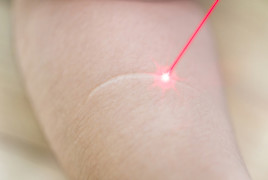
Light treatments. When
scalp psoriasis does not clear with treatment that is
applied to the scalp, light treatments may be an option.
Your dermatologist may call this type of treatment
“phototherapy.”
Until recently, light treatments were not useful for scalp
psoriasis unless the person was bald or had very thin hair.
Thanks to recent advances, even people with thick hair can
have light treatments on their scalp. Some patients are
treated with a UV comb. Others receive laser therapy.
-
Biologics and other
medicines that work throughout the body. Scalp psoriasis
can be stubborn. Sometimes it does not respond to topical
(applied to the scalp) medicine or light treatments. When a
patient needs aggressive treatment, a dermatologist may
prescribe a medication that works on the immune system. Some
of these medications come in pill form. Others require
self-injections. Sometimes the medicine is given by
infusion, which requires the patient to go to a hospital or
psoriasis treatment center.
|

Scalp psoriasis can be unbearably itchy. When people
have scalp psoriasis that does not respond to a mainstay
treatment, they often want aggressive treatment. |

This man got
relief from a biologic. Considered an aggressive
treatment, a biologic is generally not the first
treatment a dermatologist will prescribe. |
|
Photograph used with permission of the Journal
of the American Academy of Dermatology.
The photograph was published in the Journal
of the American Academy of Dermatology,
Vol. # 58, Krell
J, Nelson C, Spencer L et al.,
“An open-label study evaluating the
efficacy and tolerability of alefacept for the treatment
of scalp psoriasis,”
609-16. Copyright Elsevier (2008). Journal
of the American Academy of Dermatology. |
Medication that may be prescribed for
aggressive treatment of scalp psoriasis includes:
Most cases of scalp psoriasis can be
effectively treated. Sometimes treatment requires using more than
one treatment option. Dermatologists have the expertise required to
combine these treatments and minimize side effects.
References:
Bovenschen HJ, Van de Kerkhof PC. “Treatment of scalp psoriasis with
clobetasol-17 propionate 0.05% shampoo: a study on daily clinical
practice.” Journal of the European Academy of Dermatology and
Venereology; April 2010; 24: 439-44.
Chan CS, Van Voorhees AS, Lebwohl MG et al. “Treatment of
severe scalp psoriasis: from the Medical Board of the National
Psoriasis Foundation.” Journal of the American Academy of
Dermatology June 2009; 60: 962-71.
Krell J, Nelson C, Spencer L et al. “An open-label study
evaluating the efficacy and tolerability of alefacept for the
treatment of scalp psoriasis.” Journal of the American Academy
of Dermatology April 2008; 58: 609-16.
Poulin Y, Papp K, Bissonnette R et al. “Clobetasol propionate
shampoo 0.05% is efficacious and safe for long-term control of
moderate scalp psoriasis.” The Journal of Dermatological
Treatment; May 2010; 21: 185-92.
Poulin Y, Papp K, Bissonnette R et al. “Clobetasol propionate
shampoo 0.05% is efficacious and safe for long-term control of scalp
psoriasis.” Cutis; January 2010; 85: 43-50.

All content solely
developed by the American Academy of Dermatology
|
 |
|
 |
|

Before buying a treatment
advertised on the Internet or an infomercial, be sure to
ask your dermatologist about the treatment.
Some of these treatments for scalp psoriasis may not be
as safe as they seem. Some contain hidden ingredients
that can be harmful. |
|
|
|