





| |
Gentle
Skin Care Helps Control Rosacea
Skin care can help diminish rosacea —
or make it worse. The reason lies in your stratum corneum,
the layer of skin you see when you look in the mirror. People with
rosacea have a fragile stratum corneum, so skin is easily
irritated. Gentle skin care can help reduce irritation and calm the
skin. The following is what dermatologists recommend:
-
Avoid scrubbing or rubbing skin
affected by rosacea. Rubbing or scrubbing irritates the skin
and tends to make rosacea worse. Even using a bath puff or
washcloth on rosacea-prone skin can be too irritating.
-
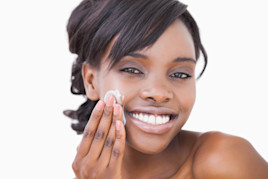
Gently cleanse rosacea-prone
skin. Following these guidelines can help reduce the
likelihood of irritating the skin:
-
Wash with lukewarm not hot
water.
-
Use a mild, fragrance-free
cleanser, or cleansing bar.
-
Apply the cleanser or lather
gently with the fingertips.
-
Rinse the skin thoroughly and
very gently with lukewarm water.
-
Gently pat water from the skin
with an absorbent cotton towel.
-
After washing, let the skin dry
thoroughly. Skin is most absorbent when wet. Applying
medication or anything else immediately after washing can cause
burning and stinging. Waiting 5 or 10 minutes can help reduce
this. If the skin still stings or feels irritated, allow more
time to pass. Some people find it helpful to wait 20 to 30
minutes.
-
Apply medication before applying
sunscreen, a barrier-repair product, or makeup. This makes
the medication more effective. Wait another 5 to 10 minutes
before applying another product.
-
Use a barrier-repair product.
More than a moisturizer, this product helps repair the skin.
Studies have shown that applying a barrier-repair emollient
twice a day can help diminish rosacea because an emollient
softens the skin and coats it to stop water loss. One
dermatologist found that patients who used a barrier-repair
emollient for one year regained a normal flush response and had
little or no redness.
To avoid irritating your skin, ask your dermatologist for a
product recommendation.
-
Wear sunscreen every day.
Sun exposure can cause rosacea to flare. Applying a sunscreen in
the morning helps to protect the skin, provided the product does
not contain ingredients that irritate the skin.
Ingredients to avoid: Sunscreen that contains
alcohol or fragrance is likely to irritate the skin, so be sure
to check the label before buying sunscreen. Some people
with rosacea find that these cause the skin to burn, itch, or
redden.
What to look for: A sunscreen is often
well-tolerated when it offers UVA and UVB protection, has an SPF
(sun protection factor) of at least 30, and contains titanium
dioxide or zinc oxide. A sunscreen that contains silicone also
can help protect the skin and minimize stinging and redness. On
the list of ingredients, silicone may be called dimethicone or
cyclomethicone.
-
Select skin care products
carefully. A number of skin care products contain
ingredients that can irritate the skin and aggravate rosacea.
Products to avoid: People with rosacea should not
use astringents, toners, and any product that exfoliates.
Ingredients to avoid: A survey conducted by the
National Rosacea Society found that several ingredients in skin
care products can irritate rosacea-prone skin. These include
alcohol, witch hazel, fragrance, menthol, peppermint, eucalyptus
oil, clove oil, and salicylic acid. Menthol, camphor, and sodium
lauryl sulfate also can irritate the skin. Many other common
ingredients have the potential to irritate the skin. If a
product causes burning or stinging — even after waiting to apply
it — stop using it.
-
Be wary of over-the-counter skin
care products that claim to reduce redness. While many
products now make this claim, this does not mean that the
product can diminish the redness of rosacea. Unless the label
specifically states that the product has been found effective
for rosacea, it is best not to chance it.
-
Choose makeup with care.
Cosmetics can dry and irritate rosacea-prone skin, but this does
not mean that makeup cannot be worn.
What to avoid: Waterproof cosmetics and heavy
foundations are best avoided because they often require makeup
remover at the end of the day. Remover can irritate
rosacea-prone skin.
What to look for: The ideal makeup is a light
foundation that contains silicone (for skin-barrier protection)
and a broad-spectrum (offers protection against UVA and UVB
rays) sunscreen.
If the skin stings or burns after applying the foundation, make
sure 25 to 30 minutes has elapsed since washing the skin and 5
to 10 minutes has passed since applying a medication or skin
care product. Try another foundation if the skin still burns or
stings.
-
Journal it. Keeping track of
what is applied to rosacea-prone skin and how the skin reacts is
important. People often respond differently to products.
Gentle skin care when used along with rosacea treatment and
trigger avoidance can effectively keep rosacea under control.
References
Crawford GH, Pelle MT, James WD. Rosacea: I. Etiology, pathogenesis,
and subtype classification. J Am Acad Dermatol 2004; 51:
327-41; quiz 42-4.
Pelle
MT, Crawford GH, James WD. Rosacea: II. Therapy. J Am Acad
Dermatol 2004; 51: 499-512; quiz 3-4.

All
content solely developed by the American Academy of Dermatology |
 |

|
If you have rosacea, the
key to successful skin care is to avoid irritating your
skin. |
|
|
|