






| |
Rosacea
Treatment
Redness,
Flushing, and Visible Blood Vessels
Subtype:
Erythematotelangiectatic type rosacea
Patients with this subtype often have
extremely sensitive skin. Any medication applied to the face may
cause intense stinging and burning. If this is the case, treatment
may begin with skin care that can help repair the damaged skin.
-
Sunscreen and a Barrier-Repair Emollient When the skin is extremely sensitive and bright red, therapy may
begin with a sunscreen that does not irritate the rosacea and a
barrier-repair emollient that is applied twice a day. Patients also
may be prescribed an oral (taken by mouth) antibiotic. Once the skin
calms, the patient may be helped with one or more topical medication
described below. Daily sunscreen use should continue indefinitely.
-
Topical Medication The redness can, in some cases, be effectively
treated with a topical (applied to the skin) medication that reduces
inflammation such as:
Effectiveness:
When using a topical medication, it can take a few months to see
noticeable improvement. In some cases, long-term use of a topical
medication can be helpful in controlling rosacea.
Side effects: These include burning, stinging, itching, and
skin irritation when applying the medication. People who have this
rosacea subtype are especially prone to these side effects. If the
skin feels too sensitive for a topical medication, be sure to let
the dermatologist know.
After applying a topical retinoid, the skin may feel warm or sting.
Sometimes redness increases temporarily. Peeling of the skin also
can occur. When using a topical retinoid, it is important to apply
sunscreen before going outdoors as topical retinoids tend to
increase sensitivity to the sun. Some patients also experience
increased sensitivity to wind and cold.
-
Electrocautery Effectiveness: Visible blood vessels can be safely destroyed
with this low-powered electrical device. Treatment involves numbing
the area, treating the affected skin with an electric current, and
then scraping away the treated skin. Electrocautery usually requires
more than one treatment.
Side effects: The most common side effects are swelling or
redness for a day or two.
-
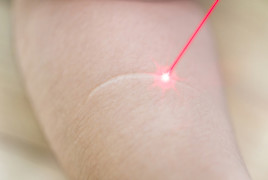
Lasers and Other Light Therapies
Effectiveness: The redness, flushing, and visible blood vessels
may be effectively treated with lasers and other light therapies.
While the number of treatments varies, most people require 4 to 8
treatment sessions per year for a few years to significantly reduce
redness and flushing. At least 2 treatments are needed to diminish
visible blood vessels. Once the desired results are seen, patients
may not need treatment again for some time. A few patients have
reported that their redness and flushing did not return for 7 or 8
years.
Side effects: The risk of side
effects is low in the hands of a physician who has experience using
these devices and in-depth medical knowledge of the skin. With newer
lasers, side effects tend to be limited to temporary bruising,
redness, or swelling. The redness and swelling can last a few days.
With some lasers, bruising may last as long as 10 to 14 days.
Beware: Laser treatments and
other light therapies should be performed by or under the direct
supervision of a physician who has expertise in the skin such as a
dermatologist. Direct supervision means that the physician is on
site while the procedure is being performed and immediately
available during the procedure.
Insurance usually does not cover the cost of this treatment because
the treatment is considered cosmetic. Patients can expect to pay
from $300 to $700 per session.
-
Other Treatment Options In some cases, rosacea does not respond to the therapies described
above. If you have been following the prescribed treatment plan and
treatment fails, be sure to discuss this with your dermatologist.
Less commonly used treatment may be an option.
References:
American Academy of Dermatology. “Acne and Rosacea Getting You Down?
Laser, Light and Cosmetic Treatments Give Patients a Much-Needed
Boost.” News release issued February 3, 2008.
Last accessed June 4, 2008.
Baldwin HE. “Systemic Therapy for Rosacea.” Skin Therapy
Letter.com March 2007; 12. Available at
www.skintherapyletter.com/2007/12.2./1.html. Last accessed May
15, 2008.
Crawford GH, Pelle MT, James WD. “Rosacea: I. Etiology,
pathogenesis, and subtype classification.” J Am Acad Dermatol
2004; 51: 327-41; quiz 42-4.
Pelle MT, Crawford GH, James WD. “Rosacea: II. Therapy.” J Am
Acad Dermatol 2004; 51: 499-512; quiz 3-4.

All
content solely developed by the American Academy of Dermatology |
 |
 |
-
Redness that develops
in the center of the face
-
Flushing that lasts
longer than 10 minutes
-
Burning or stinging
sensation may accompany flushing
-
Visible blood vessels
-
Burning or stinging
when a product such as a lotion, hairspray, or
cosmetic touches the face
As the rosacea progresses,
the redness may spread beyond the center of the face. It
may affect the ears, neck, and upper chest. The skin
around the eyes is spared.
|
|
|
|