








|
SkinCancerNet Spotlight Article
The Dark Side of Tanning Beds: One Woman's Story
|
From tanning-salon customer
to skin-cancer patient in just four years, Kimberly
Sanga's mission is to raise awareness of the health
risks associated with indoor tanning. |
Patient Profile
At age 14, Kimberly Sanga wanted a
killer tan. Blonde and fair-skinned, she thought a tan would make
her look more attractive, so she stopped by her local indoor tanning
salon and signed up for unlimited sessions. The buzz about the
dangers of tanning did not faze her. All of her friends were using
tanning beds, so she figured, “How bad could it be?”
More than 20 skin-cancer surgeries
later, Kimberly knows how bad it can be. Scars from these surgeries
crisscross her entire body. She has had 40-plus suspicious lesions
removed. One surgery required 25 stitches in her groin.
Some of these excised lesions were
basal cell carcinoma, the most common type of skin cancer. Others
turned out to be squamous cell carcinoma, a type of skin cancer that
can spread. Kimberly now worries that she could be diagnosed with
melanoma, the deadliest form of skin cancer. Her doctor shares this
concern.
Suffering Lifelong Consequences
While Kimberly has not slipped into a tanning bed for 13 years, new
growths continue to appear at a rate that alarms her. Within the
past month, over a dozen new moles have developed. Kimberly
continues to see her doctor regularly. Sometimes it is once every 3
months; other times she needs monthly visits. Lately, a routine has
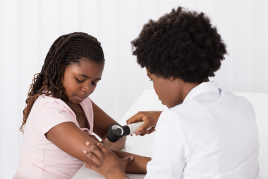
emerged. First she undergoes a full-body exam. Then suspicious
lesions are removed.
While Kimberly knows what to expect, it
does not make these visits any easier. Having lesions removed, she
confesses, still disturbs her. “My doctor gives me a local
anesthetic, but I can feel the tugging sensation as the scalpel
moves across my skin.”
At least the skin-cancer surgery is
quickly over. Waiting for the biopsy report, which provides the
diagnosis for each excised lesion, is agonizing. “I try to visualize
what I would say or how I would feel if the diagnosis comes back
melanoma,” she says. “I think about what stage it would be and what
the next step would be. I am always wondering how fast my dysplastic
moles will change into cancer.”
To increase her chance of finding skin
cancer in the earliest stage when the cure rate averages 95%,
Kimberly examines her moles every other day. She is grateful to her
husband, Shawn, who makes it his responsibility to examine her back.
Between them, they look at the size, shape, and color of every mole
on her body — current count 72.
Despite all she is doing to improve her
chances, she still feels uncertain about her future. She feels
cheated out of some of life’s simplest pleasures. There is no such
thing as enjoying a day outdoors. This pained her most on her
honeymoon. At Disney World, they had to plan their time so that they
were indoors during the peak sun hours.
Reaching Out to Teens
Despite the challenges and a full-time career, Kimberly somehow
finds the energy and time to raise awareness of the risks associated
with tanning. She especially wants teenagers to know her story and
about the dark side of tanning. “One of the scariest things I see is
people under 20 crowding the tanning salons in my town year round.”
To reach local teens, Kimberly
partnered with the chief of police in her hometown, a fellow cancer
survivor, to create a forum at the local high school. They plan to
hold the first forum this spring, just before spring break and prom
season when teenage tanning bed use peaks.
To emphasize what can happen with just
a few years of tanning, Kimberly will show photographs of her scars.
She will tell these teens that she started using tanning beds at age
14 and was diagnosed with her first skin cancer after only 4 years
of tanning. With heartfelt emotion, she will explain that the skin
cancer removed from her breast at age 18 — a basal cell carcinoma —
only develops with exposure to ultraviolet (UV) rays. Even people
who spend their lives outdoors in the sun tend not to develop basal
cell carcinoma until their 40s, 50s, or 60s.
She will point out that tanning beds
have changed this. Today, young, healthy people are developing skin
cancer.
Kimberly wants everyone to know that
she is not the first teenager to use tanning beds and develop skin
cancer. She mentions fellow skin cancer survivor, Brittany Lietz who
was crowned Miss Maryland in 2006. Brittany started indoor tanning
while in high school. It was not long before she found herself
slipping into a tanning bed 4 times a week. At age 20, Brittany was
diagnosed with stage II melanoma.
Like Brittany, Kimberly encourages
teens to think first. “Before you slip into a tanning bed, think
about your future and the damage you are doing,” she pleads. If she
can reach them, Kimberly believes they will never know the life she
now leads.
Real Stories: Other Young Women Who
Used Tanning Beds and Developed Skin Cancer
Getting Burned by Tanning Beds
Melanoma Diagnosis: Stepping Stone for Miss Maryland

All
content solely developed by the American Academy of Dermatology |