







|
Ask the Dermatologists
Follow-up care is essential after treatment for skin cancer, my
dermatologist told me. My problem is that I do not remember much
that my dermatologist said about follow-up care. I felt so
distracted by my diagnosis that I could not concentrate. Will you
please summarize?
Follow-up care is essential
because skin cancer can return and new skin cancers can develop.
Making follow-up care a part of your lifestyle will help reduce
these possibilities.
If you forgot what your dermatologist said, call the office and ask
for a written copy of your guidelines for follow-up care. Each
patient has unique needs, so guidelines differ. As soon as you
receive your guidelines, read them carefully. Should you have any
questions, contact your dermatologist.
While you are waiting for your individualized guidelines, be sure to
read these general guidelines that dermatologists recommend:
-
Adopt a comprehensive
sun-protection plan. Having had skin cancer, you have an
increased risk of developing another skin cancer. Most skin
cancer develops in skin badly damaged by the sun’s ultraviolet
(UV) rays. Protecting your skin from further damage can reduce
this risk.
To protect the skin, dermatologists
advise their skin-cancer patients to:
-
Wear sun-protective
clothing. Before going outdoors, dermatologists
recommend that their skin-cancer patients put on clothing
that covers the legs, long sleeves, sunglasses, and a
wide-brimmed hat. The brim should encircle the entire hat
and be wide enough to shade the face, back of the head, and
neck.
It is important that the clothing effectively block harmful
UV rays. An easy way to find out how much sun protection
clothing offers is to hold up the garment to a light or
sun-filled window. If plenty of light passes through, the
clothing does not offer adequate sun protection.
-
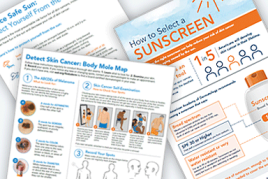
Generously apply sunscreen
every day to all skin that is not covered by sun-protective
clothing. Use sunscreen that offers broad-spectrum
protection — meaning that it protects against UVA and UVB
rays. The sunscreen also should have a sun protection factor
(SPF) of at least 30. Apply sunscreen 20 minutes before
going outdoors. Be sure to apply it to all skin that will be
exposed. Do not forget the ears, neck, and between the
fingers. Sunscreen should be applied year round. Even on a
cloudy day, 80% of the sun’s UV rays pass through the
clouds.
-
Avoid direct sun exposure.
Dermatologists advise avoiding outdoor activities when
the sun’s rays are strongest — between 10 a.m. and 4 p.m.
If you must be outdoors, be sure to re-apply sunscreen
approximately every
2 hours and after perspiring or swimming, wear
sun-protective clothing, and seek shade as much as possible.
It also is important to know that extra caution is needed
near water, snow, and sand. These reflect the damaging rays
of the sun.
-
Never use a tanning bed,
sunlamp, or any other indoor tanning device. Research
has found that tanning lamps emit UV rays that can be up to
15 times stronger than the sun.
-
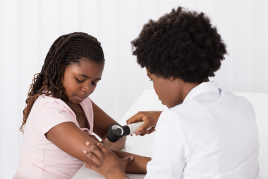
Learn how to perform a full-body
self-exam of your skin. You probably learned how to perform
this self-exam in your dermatologist’s office. You will find an
illustrated guide to the skin self-exam on this site at:
Skin Examinations
If you have any questions about this exam, be sure to ask your
dermatologist.
-
Perform full-body self-exams
regularly. Performed regularly, the self-exam can help
detect skin cancer in its earliest stage. This can be life
saving. Skin cancer, including melanoma, averages a 95% cure
rate with early detection and treatment.
If you find a suspicious lesion, contact your dermatologist
immediately.
-
Have regular dermatologic
check-ups. Patients often feel reluctant to schedule
check-ups for fear that the doctor will find cancer. In reality,
a check-up often eases a patient’s mind. Imagine hearing that
you are cancer free.
If skin cancer does develop, early detection and treatment offer
the highest cure rate.
A check-up also allows you to ask about anything that concerns
you. Do not be shy. If a lesion worries you or you have another
concern, speak up. Questions often arise between visits. Be sure
to write down your questions and concerns so that you can
discuss these with your dermatologist during your next
appointment.
These are the general guidelines for
follow-up care. Your dermatologist should have given you slightly
different guidelines due to how advanced your cancer was when
treated, the treatment, and your medical history. It is important to
speak with your dermatologist about your specific needs and make
follow-up care an integral part of your life as a cancer survivor.

All
content solely developed by the American Academy of Dermatology |
 |
 |
|
Have you ever wished you
could ask a team of dermatologists a question about skin
cancer? Send your question to the
SkinCancerNet Mailbag.
While we value your
questions and ideas, we cannot answer every question.
Only questions about skin cancer will be considered.
A panel of board-certified dermatologists who specialize
in skin cancer will review the questions submitted to
this site and select a few questions. All answers
will appear on the Web site. You will not receive
a reply, so be sure to check this site.
Too busy to check back?
You can learn what new information has been posted,
including questions and answers, by signing up for the
American Academy of Dermatology's
free monthly e-newsletter. |
|
|
|