








|
Glossary
5-year survival rate: Expressed
as a percentage, this is the likelihood that a patient will be alive
in 5 years.
Actinic keratosis (pl.
keratoses): A lesion that may form on skin exposed to the
ultraviolet (UV) rays of the sunlight for many years. The lesion can
progress to squamous cell carcinoma, a type of skin cancer that can
spread.
ABCDEs of melanoma detection:
ABCDE is an acronym used to help people remember the key
characteristics of melanoma detection. A = asymmetry, B = border
irregularity, C = color within varies, D = diameter, and E =
evolving. If you notice a
mole different from others, or which changes, itches, or bleeds even
if it is smaller than 6 millimeters, you should see a dermatologist.
Acral lentigious melanoma: See
melanoma.
Adjuvant therapy:
Any treatment
given after the first that is intended to
increase the effectiveness of the first treatment.
Atypical
mole: See
dysplastic.
BCG:
Bacille Calmette-Guérin (BCG) is a vaccine made from a form of
killed tuberculosis that is used to immunize people against
tuberculosis (TB). This vaccine is being investigated as a possible
treatment for advanced melanoma.
Biopsy:
Removal and microscopic examination of tissue from
the body for the purpose of establishing a precise diagnosis. A
biopsy is required to confirm a skin cancer diagnosis. During an
excisional biopsy, the entire skin lesion is removed for
microscopic examination. When an incisional biopsy is
performed, a portion of the skin lesion is removed.
Basal
cell carcinoma: A type of skin cancer that arises in
the basal cells, which are located in the epidermis (outermost
layers of the skin). It can take many forms and accounts for about
80% of all skin cancers. Basal cell carcinoma can be locally
invasive, but rarely metastasizes.
Benign: Not
malignant.
Blinded:
Term used in an investigational study, such as a clinical trial,
that means none of the volunteers know if they are receiving the
investigational treatment, standard treatment, or a
placebo (if a placebo is used). When both the
volunteers and researchers do not know who is receiving which
treatment, the study is said to be “double blinded.”
Breslow’s thickness: See
thickness.
Chemotherapy:
Use of anti-cancer medications to kill cancer cells that survive
surgery or cannot be reached by surgery. Chemotherapy also may be
used in the late stages to reduce symptoms or the size of a tumor.
Clark level of invasion: Classification system developed by
dermatopathologist, Wallace Clark, MD, that indicates how deeply a
primary melanoma tumor has penetrated the skin. Five levels are
used. Level I, also called “melanoma in situ” indicates that the
melanoma is confined to the epidermis, the outermost layer of the
skin. Levels II - IV indicate that the tumor has invaded the dermis,
the middle layer of the skin, and each of these levels corresponds
to a different depth. When a melanoma is classified as a Level V, it
has invaded the subcutis, the fatty layer under the skin.
Clinical trial:
A medical
investigational study in
which humans are observed and/or treated. A study may investigate a
new treatment, prevention strategy, diagnostic method, screening
procedure, or how to improve comfort and quality of life.
Control: In an investigational
study such as a clinical trial, this is the group that receives the
standard treatment, no treatment, or a placebo rather than the
treatment being studied.
CT scan:
Computed
tomography (CT), which is sometimes called a CAT scan, combines
x-ray and computer technology to produce cross-sectional images of
the body. Unlike an x-ray, which images bones, computed tomography
can produce an image that shows everything in that area of the body,
such as organs, bones, and blood vessels. These images can help
detect cancer that has spread to an organ or a lymph node.
Cytokines:
Proteins produced naturally in the body that act as "messengers" to
initiate inflammatory and disease-fighting responses to viruses,
bacteria, toxins, injury, and malignant processes. Cytokines are in
use as anti-cancer medications.
Dermatopathologist: A medical
doctor trained in both dermatology and pathology who uses this
expertise to microscopically examine tissue in order to diagnose
skin conditions, often providing expertise in diagnosing difficult
cases.
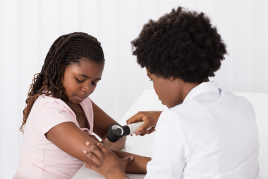
Dermatoscopy:
Also called “surface microscopy,” “dermoscopy,” and
“epiluminescence microscopy,” this is a noninvasive technique used
by dermatologists to examine pigmented and some non-pigmented
lesions. The technique involves using a handheld microscope-like
device that allows the dermatologist to see through the stratum
corneum (bottom of the outermost layer of skin), permitting a
detailed view of structures within the skin that are usually
invisible to the unaided eye. Dermatoscopy can aid in early
detection, help determine which skin lesions should be biopsied, and
assist surgeons in determining how much normal-looking skin to
remove.
Dermis:
The middle
layers of skin, which consists largely of collagen and elastin and
supports the upper layers (the epidermis).
Distant: Cancer has spread from
the original tumor and beyond the lymph nodes closest to the
original tumor to other lymph nodes and/or organs.
Distant site:
Once skin
cancer spreads beyond the lymph nodes nearest the original (primary)
tumor, it has traveled to a “distant site.” A distant site may be an
internal organ, skin not near the primary tumor, or lymph nodes
other than those closest to the primary tumor.
Double blinded: See
blinded.
Dysplastic:
An alteration in size, shape, and organization of cells. A
dysplastic nevus, also called an “atypical mole,” is characterized
by the ABCDs of melanoma
detection.
Epidermis: Outermost layers of
skin.
Fine needle aspiration
biopsy:
Also called FNA, this type of biopsy is performed by inserting a
long, thin needle in order to extract a small amount of tissue. The
tissue is examined under a microscope to find out if cancer cells
are present. This type of biopsy may be used to collect cells from
an enlarged lymph node or an internal organ, such as the liver or a
lung.
Immunotherapy: Treatment that repairs, stimulates, or
enhances the body’s own immune responses to fight established
disease. It is sometimes combined with chemotherapy.
In situ:
Skin cancer exists in the outermost layer of skin only and is said
to be in stage 0. The term “in situ” literally means “in the
original position or place.”
Informed
consent: When a person agrees to volunteer for a clinical trial,
the person agrees in writing that he or she has been informed
about what will occur during the study, the risks and benefits,
whether or not the study will be blinded, and
other key information. A volunteer can withdraw at any time;
however, it is hoped that every volunteer will stay for the duration
of the clinical trial.
Interferon:
Interferons are
substances within the immune system that are produced in response to
infection. One type, interferon-alpha, is FDA-approved for treating
melanoma in certain stages when used along with another therapy,
such as surgery. In these stages, interferon-alpha injections can
help prevent recurrence and increase the likelihood that all cancer
is eliminated.
Interleukin:
Interleukins activate the “killer” activities of specific white
blood cells in the immune system. One specific interleukin, IL-2,
helps the immune cells reproduce more quickly and is used to treat
melanoma that has spread.
Intravenous:
Within a vein or administered directly to a vein. Some medications,
such as dacarbazine (DTIC) which is used to treat advanced melanoma,
are administered this way.
Isolated limb perfusion:
A modified form of chemotherapy that involves temporarily stopping
the flow of blood to an affected limb with a tourniquet and
administering a high dose of chemotherapeutic medication to the
affected area. It is believed that high doses can more effectively
destroy the cancerous cells.
LDH:
Lactate dehydrogenase (LDH) is an enzyme found in most of the body’s
tissues. When tissue cells are damaged or destroyed, they release
LDH into the bloodstream, and the LDH level, which is normally low,
rises. When a blood test shows the patient has elevated LDH levels,
this may indicate that cancer cells are present or that an organ has
been damaged by cancer.
Lentigo maligna: The
in situ form of lentigo maligna melanoma.
Lentigo maligna melanoma: See
melanoma.
Level:
See Clark Level of Invasion.
Lymphadenectomy:
Surgery to
remove lymph nodes.
Lymph node:
Part of
the immune system, lymph nodes are small bean-shaped glands
found throughout the body. The glands trap bacteria, viruses, and
other foreign substances, such as cancer cells. Lymphocytes, a type
of white blood cell, work to destroy the foreign substances.
Clusters of lymph nodes can be felt in the neck, groin, and under
the arms. In these areas, the lymph nodes can swell noticeably when
fighting foreign substances.
Malignant:
When referring to cancer, the ability to grow and spread in an
uncontrolled manner beyond the local confines of the tumor.
Margin:
Refers to the amount of normal-appearing tissue to be removed along
with the tumor during surgical excision. The thicker the tumor, the
more normal-looking skin the surgeon removes. Margin is usually
measured in centimeters. Current recommended surgical margins for
melanoma are:
|
Tumor Thickness (millimeters)
In situ melanoma
less than 1.0
1.0 - 4.0
more than 4.0 |
Excisional Margin (centimeters)
0.5
1.0
2.0
at least 2.0 |
Surgical margins may be modified for an
individual patient after considering medical or esthetic reasons.
The main goal is complete removal of the cancer.
For an explanation of the relationship
between tumor thickness and 5-year survival rate, see
thickness.
Melanocytes:
Cells that make melanin, the substance that gives skin its
color. Melanin is made in small granules, called melanosomes, within
the melanocyte. Melanin is then transported to cells in the outer
skin (keratinocytes), where the melanin is seen as the "color" of
the skin.
Melanoma:
A cancerous tumor that arises in the
melanocytes and accounts for about 4% of all skin cancers. Four
types of melanoma are most common:
-
Acral lentiginous
melanoma (ALM): The most common melanoma in dark-skinned
people, it appears on palms, fingers, toes, soles, mucous
membranes, and underneath fingernails and toenails. This tumor
accounts for 2% of melanomas in Caucasians and 50% in dark-skinned
races. As the tumor is frequently mistaken for a bruise or nail
streak in its early stages, ALM is often not diagnosed until the
later stages when the tumor is very aggressive.
-
Lentigo maligna melanoma (LMM): Melanoma that develops in a
sun-induced freckle. It typically occurs on sun-damaged skin in
the elderly and may be mistaken in its early, and most treatable,
stages for a benign "age spot" or "sun spot." It accounts for
about 10% of melanomas diagnosed in the United States. Since LMM
is so easily mistaken as a benign patch of
mottled skin, it can go undetected for years. This can be quite
dangerous.
-
Nodular melanoma: A very aggressive form of melanoma that
tends to grow "down" into deeper skin tissue rather than along the
surface of the skin. It accounts for approximately 15% of
diagnosed melanomas.
-
Superficial spreading melanoma: This is the most
common type of melanoma, which accounts for about 70% of all
diagnosed melanomas. This melanoma usually spreads along the
skin’s surface (epidermis) and then grows "down" into deeper skin
tissue (dermis). It is curable when it is removed before it
invades the dermis.
Less common types of melanoma include:
-
Amelanotic melanoma: When this type of melanoma
occurs, not enough pigment is produced to create a dark-colored
lesion. Instead, the lesion may be skin-colored or slightly
reddish like an insect bite. It usually appears as a pink or red
nodule.
-
Desmoplastic neurotrophic melanoma: This usually looks like
a non-pigmented scar-like lesion. It is suspected if a lesion,
such as a scar or keloid, is found and persists at a site when no
injury occurred to cause the lesion. The tumor may be pigmented or
non-pigmented and most commonly appears on sun-damaged skin of the
head and neck in elderly adults.
-
Mucosal melanoma: This melanoma occurs in mucosal
regions of the mouth, nose, and genitals. It may not be recognized
because it occurs in sites that are infrequently examined.
Merkel Cell Carcinoma
A rare type of skin cancer, Merkel cell carcinoma is usually
diagnosed in people aged 65 and older. This skin cancer generally
begins as a rapidly growing, raised, red-to-violet colored nodule
that appears on skin which has received years of sun exposure. The
incidence of Merkel cell carcinoma is growing. There are now more
than 1,000 cases each year in the United States. Treatment usually
involves surgically removing the nodule. Radiation therapy and
chemotherapy also may be used.
Metastasis:
The spreading of disease from one part of the body to another. Both
melanoma and squamous cell carcinoma metastasize. Melanoma most
often spreads to the lymph nodes, liver, abdomen, lungs, bone, skin,
heart, and brain.
Mohs
micrographic surgery:
A
highly specialized surgical technique in which all remaining visible
parts of the tumor are excised and skin is removed layer by layer
and examined under a microscope while the patient is undergoing
surgery. Skin continues to be removed until cancer is no longer
detected. Not necessary for removing all skin cancers, it may be
used when the primary tumor is located on the face or another area
where it is essential to preserve as much healthy tissue as
possible, the tumor is large, it is difficult to determine where the
cancer ends, or the skin cancer has recurred.
Monoclonal antibodies: Laboratory-produced molecules
that can be directed to "lock on" to specific cells, parts of cells,
or other molecules, either to identify them for diagnostic purposes
or to kill them in therapy. Monoclonal antibodies are still
experimental in many instances.
Mole:
See
nevus.
MRI:
Magnetic resonance imaging (MRI) is medical diagnostic technique
used to produce detailed images of internal organs and other soft
structures within a patient’s body. This test may be used to detect
a tumor or assess the effectiveness of a cancer treatment. During an
MRI, a powerful magnetic field and pulses of radio waves pass over
the patient’s body. This activity is recorded by a computer that
translates the activity into images. This test may not be suitable
for a patient with an implanted pacemaker or who has any metal
imbedded in the body. To avoid potentially serious complications, be
sure to tell your doctor and the technicians if you have any metal
in your body before undergoing an MRI.
Nevus
(pl nevi):
What dermatologists
call a “mole,” this usually pigmented skin lesion may be
present from birth, but most often appears later in life. By age 3,
approximately 80% of children will have at least one mole. There are
dozens of different types of moles, of many shapes, colors, and
sizes. Most moles are not cancerous. Occasionally, a mole may become
a cancerous growth.
Nodular melanoma:
See melanoma.
Open biopsy:
An incision is
made in order to surgically remove tissue so that it may be examined
under a microscope. This type of biopsy may be performed when a
patient has melanoma and a lymph node near a melanoma feels hardened
or enlarged. The lymph node in question is surgically removed and
examined under a microscope to see if it contains melanoma cells.
Palliative care: Relieves
symptoms and improve a patient’s quality of life, but does not treat
the disease.
PET scan:
Positron emission tomography, better known as a PET scan, is a
medical test that can be used to detect cancer cells and evaluate
the effectiveness of cancer treatment. This test involves injecting
a small amount of radioactive substance, usually glucose, into the
patient’s vein. The radioactivity is tracked with a special camera
that shows how the substance is absorbed. Cancerous tissue absorbs
more glucose than normal tissue and appears brighter.
Placebo:
A pharmacologically inactive substance with no medicinal value. It
can be used as a “control” in blinded clinical trials.
Precursor:
A lesion that has the potential to develop into skin cancer.
Primary
tumor: The first appearance of a tumor. In skin cancer,
there may be multiple primary tumors.
Randomized: Term used in an
investigational study, such as a clinical trial, that means the
volunteers have been randomly assigned to a control group
(volunteers do not get the investigational treatment)
or study group
(volunteers get the investigational treatment). Randomizing ensures
that the results can be compared objectively.
Recurrent tumor: Tumor that was
treated but has returned.
Regional: Cancer that has spread
beyond the site of the primary tumor to nearby lymph nodes and
sometimes tissue/organs close to the primary tumor.
Risk factor:
A attribute that increases the likelihood that something will occur.
Personal risk factors for skin cancer include fair skin, especially
when combined with blond or red hair and blue, gray, or green eyes;
long-term unprotected exposure to sunlight; tendency to freckle;
tendency to sunburn rather than tan; atypical moles; and personal
history of skin cancer.
Sentinel lymph
node biopsy:
A diagnostic surgical procedure used to find out if the melanoma has
spread to the lymph nodes. It involves the surgeon identifying the
first lymph node, known as the "sentinel node," to receive lymph
draining from the site of the primary tumor.
The sentinel node is found by injecting radioactive material and/or
dye into the
skin near
the tumor and tracing the flow of lymph from the site of the tumor
to the local and regional lymph nodes. Once the sentinel node is
identified, it is surgically removed and sliced into sections for
laboratory analysis to determine if cancer cells are present.
Sometimes, the surgeon will remove two or three nodes.
Squamous cell carcinoma: Skin cancer that forms in
the flat, scale-like skin cells of the epidermis called the squamous
cells. It accounts for approximately 16% of all skin cancers. This
cancer can metastasize and cause death.
Stage:
How far the cancer has advanced. The staging process determines
whether the cancer is confined to the primary tumor or if it has
progressed to the lymph nodes or distant organs.
Subcutis:
Literally, this
means “beneath the skin.” The subcutis also is defined as the bottom
layers of skin. These layers consist mostly of fat cells. Blood
vessels, nerve fibers, and muscle fibers also are found in the
subcutis. Thickness of the subcutis varies throughout the body and
depends on the amount of fat present. Therefore, the subcutis is
much thinner on the eyelids than the buttocks.
Superficial spreading
melanoma: See melanoma.
Thickness:
In 1975, Alexander Breslow, MD, observed that the depth of a tumor
(how deeply the tumor extends into the skin) correlates to the
5-year survival rate after surgical removal of the tumor. This has
come to be known as “Breslow’s thickness,” which is documented in
the table below:
|
Breslow Thickness (millimeters)
less than 0.76
0.76-1.50
1.51-2.50
2.51-4.0
4.1-8.0
more than 8.0 |
5-Year Survival (%)
97
92
76
62
52
32 |
Survival rates, like insurance survival
tables, are statistical aggregates. Please keep in mind that it is
impossible to determine survival for an individual patient.
Ulceration: A break in the
surface of a skin cancer tumor, which is often only seen under the
microscope. When such a break occurs, the tumor is said to be
“ulcerated.”
Vaccine therapy: A type of
immunotherapy. Still experimental, some
patients with advanced melanoma are receiving a vaccine, which is
similar to the vaccines that protect us against viruses, in hopes
that the small amount of melanoma injected into the patient will
enable the body to attack the melanoma.

All
content solely developed by the American Academy of Dermatology |