








|
SkinCancerNet Article
Melanoma Can Run in Families
What
we know about the "melanoma" genes
Like breast cancer, melanoma is a
cancer that can run in the family. Between 5% and 10% of people who
develop melanoma have a family history of this deadly skin cancer.
For some of these families, the genes for light-colored skin and
other physical traits that increase the risk of skin cancer combine
with years of unprotected sun exposure to cause the melanoma. But,
researchers know this is not the case for all families with a
history of melanoma.
In a few families, gene mutations that can be passed from one
generation to the next increase the risk of developing melanoma.
While not everyone in a family inherits one of these gene mutations,
those who do have a greatly increased risk of developing melanoma.
Clues that a Melanoma Gene Runs in the Family
Often gathering a family history provides enough information to find
out if a gene mutation for melanoma runs in the family. When a gene
mutation for melanoma is passed down, the family tree often reveals
the following:
-
2 or more first-degree relatives
(parent, sibling, or child) or 3 or more blood relatives developed
melanoma
-
Multiple generations developed melanoma
-
Family members developed melanoma in
their 40s, 30s, or at an even younger age
-
Family members with melanoma usually
developed more than 1 primary (original) melanoma
-
Family history of cancer of the
pancreas
The more traits seen in the family
tree, the more likely it is that a gene mutation for melanoma runs
in the family.
Talking with relatives about skin cancer can have another benefit as
one study found. When researchers set out to confirm a family
history of melanoma by speaking with the affected family member or
looking at the family member’s medical records, they learned that
82% of the relatives believed to have melanoma did not have
melanoma. They had another type of skin cancer. This news relieved
many who believed that they would eventually develop melanoma.
Other Risk Factors Play a Role
Dermatologists caution that while a family history of melanoma
increases the risk of developing this skin cancer, it does not mean
that everyone who inherits such a gene mutation will eventually
develop melanoma. Research suggests that a number of risk factors
play a role — even in people carrying a gene mutation for melanoma.
Some risk factors, such as sun exposure and tanning-bed use, can be
controlled.
How to Improve the Prognosis
While the genes we inherit from our parents can increase the
risk of developing melanoma, prevention and regular screenings can
improve the prognosis (a forecast of the probable outcome).
Dermatologists recommend that everyone with a family history of
melanoma:
-
Avoid sun exposure. This means
following a comprehensive sun-protection plan, which includes
wearing protective clothing and applying sunscreen every day before
going outdoors. The sunscreen should be broad-spectrum (offers
protection from UVA and UVB rays) and have an SPF (Sun Protection
Factor) of 15 or greater. To protect the skin, the sunscreen must be
applied 20 minutes before going outdoors.
-
Never use a tanning bed or other
artificial tanning device. Dermatologists recommend self-tanning
lotions to their patients who want the look of a tan. Even when
using a self-tanner, be sure to apply a broad-spectrum sunscreen 20
minutes before going outdoors.
-
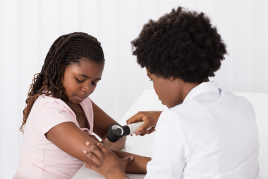
Be under the care of a dermatologist.
Regular examinations help detect suspicious changes that can be skin
cancer. Research shows that dermatologists more accurately detect
skin cancer than do other doctors. With early detection and
treatment, melanoma has a 95% cure rate.
-
Perform self-exams regularly.
Between office visits, patients should regularly examine their
bodies for signs of skin cancer. Everyone with a family history of
melanoma should know how to perform this self-exam. A dermatologist
should examine any new growth or change immediately.
People with a family history of
melanoma may develop more than 1 primary (original) melanoma.
Several studies have found that their prognosis is no worse than for
patients who have 1 melanoma.
About Genetic Testing
People often believe that if they are under a doctor’s care
because they have an increased risk of developing melanoma, genetic
testing follows. Genetic testing involves drawing a person’s blood
in order to check for a gene mutation. While a blood test can detect
a known gene mutation that increases the risk of developing
melanoma, this medical test is not routine.
Debate continues as to whether or not the information provided by
genetic testing for melanoma is useful. To date, 3 gene mutations
have been discovered. Researchers suspect that more, yet unknown,
gene mutations that increase the risk of developing melanoma exist.
If a gene mutation is not found, the person may have a false sense
of security. Additionally, finding a gene mutation usually does not
change a dermatologist’s recommendations for screening and
preventive care.
Concerns about the possibility of genetic discrimination also exist.
Genetic discrimination means that an employer or a company that
sells insurance could use the information to discriminate against
the person. For example, an insurance company could use this
information to justify increasing a person’s premiums or denying
coverage.
This is not to say that genetic testing is never recommended.
Sometimes genetic testing is needed to assess a person’s risk of
developing melanoma. When genetic testing is recommended, the
patient should meet with a genetic counselor first. Genetic
counseling educates the patient about genetic testing and assists
the person in selecting genetic testing options.
On the Bright Side
While having an increased risk of melanoma can be frightening,
knowing this can be life-saving. With early detection and treatment,
melanoma has a 95% cure rate. Regular exams play a key role in early
detection.
References:
Burden AD et al. “Genetic and Environmental Influences in the
Development of Multiple Primary Melanoma.” Archives of
Dermatology. 1999. March;135(3):261-265.
Ferrone CR et al. “Clinicopathological Features of and Risk Factors
for Multiple Primary Melanomas.” Journal of the American Medical
Association. 2005. October 5;294(13):1647-1654.
Niendorf KB et al. “Cutaneous melanoma: family screening and genetic
testing.” Dermatologic Therapy. 2006. Jan-Feb;19(1):1-8.
Pasquini P et al. “Does Assessment of Family History of Melanoma
Provide Valid Information?” Archives of Dermatology. 1999.
December;135(12):1527-1528.
Piepkorn M. “Melanoma genetics: An update with focus on the
CDKN2A(p16)/ARF tumor suppressors.” Journal of the American
Academy of Dermatology. 2000. May;42(5 Pt 1):705-722.

An educational program brought to you by the American Academy of
Dermatology. |
 |
 |
|
Prevention
In-depth sun-protection tips
Skin Examinations
Detailed information about
how to perform a skin examination and what to expect
from a dermatologist's exam |
|
|
|