









Skin Examinations

Two types of skin examinations are used to detect skin cancer:

Self-Examination
Skin cancer has a 95% cure rate when detected early, and a key to early detection is regular self-examinations of your skin. Everyone, not only those with an increased risk of developing skin cancer, should perform regular skin examinations. Examining your skin for suspicious moles and other lesions could save your life.

To perform a self-examination, you will need a:

  • Full-length mirror

  • Handheld mirror

  • Well-lit room that offers privacy

Examining your skin consists of standing in front of a full-length mirror to visually examine your body for signs of skin cancer and using a handheld mirror to view areas that cannot be seen without a second mirror. It is important to visually inspect your entire body as skin cancer can occur anywhere, not only on areas frequently exposed to the sun. Be sure to check your back, scalp, underarms, genitalia, palms, soles, and areas between the toes and fingers. When examining your scalp, it may help to systematically part the hair to check the entire scalp. An illustrated guide that shows how to examine your skin is shown on the right.

What to look for. You should become familiar with your birthmarks, blemishes, and moles so you know what they look like and can spot changes. As you examine your skin, look for changes in the size, color, shape, or texture of a mark on your skin. Signs of skin cancer include:

  • Sore that never fully heals

  • Translucent growth with rolled edges

  • Brown or black streak underneath a nail

  • Cluster of slow-growing, shiny pink or red lesions

  • Waxy-feeling scar

  • Flat or slightly depressed lesion that feels hard to the touch

Pay special attention to moles, especially one that has recently changed, bleeds, or itches. When looking at moles, keep in mind the ABCDs of Melanoma Detection:


A
symmetry – Does one half of a mole look different from the other?


B
order Irregularity – Is the edge (border) of the mole ragged, notched or blurred?


Color – Does the mole have variety of hues and colors within the same lesion?


Diameter – What is the size of the mole? While melanomas are usually greater than 6 millimeters (about the size of a pencil eraser) in diameter when diagnosed, they can be smaller. If you notice a mole different from others, or which changes, itches, or bleeds even if it is smaller than 6 millimeters, you should see a dermatologist.

If you find a suspicious lesion. Any lesion that resembles one described above or that you believe may be skin cancer should be examined by a dermatologist immediately. Don’t delay in contacting a dermatologist; skin cancer has a high cure rate when detected early, and early treatment may help minimize the surgical scars.

Examination by a Dermatologist
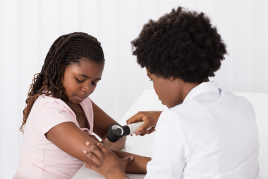
Dermatologists also visually examine the skin to detect skin cancer. Sometimes a dermatologist will use a dermoscope, a handheld microscope-like device, to examine a patient’s moles. In some cases, photographs also may be taken and used in follow-up examinations to help spot changes. If a dermatologist finds a lesion that appears to be skin cancer, the lesion will be removed and examined under a microscope (biopsy). A biopsy is the only way to confirm a skin cancer diagnosis.

Anyone who has had skin cancer or has an increased risk of developing skin cancer should be examined by a dermatologist regularly.

Regular dental, ophthalmologic, and for women, gynecologic check-ups should include an examination for pigmented lesions and other signs of skin cancer on the respective areas of the body.


An educational program brought to you by the American Academy of Dermatology.

The following illustrates how to examine your skin for signs of skin cancer. Information about what to look for and details on how to examine your skin are described on the left.


Examine your body front and back in the mirror, then right and left sides with arms raised. Women should look under their breasts.


Bend elbows and look carefully at forearms, upper underarms, and palms.


Look at the backs of your legs and feet, the spaces between your toes, and on the soles. If you cannot see all parts of your feet, use a handheld mirror.


Examine the backs of your neck and scalp with a hand mirror. Part your hair to examine the entire scalp.


Finally, check your back and buttocks with a hand mirror.

Visual guides designed to help you detect skin cancer:

Basal Cell Carcinoma: What it Looks Like

Melanoma: What it Looks Like

Squamous Cell Carcinoma: What it Looks Like

     © American Academy of Dermatology, 2008  All rights reserved.erved.
 

Disclaimer           Copyright Information