









|
SkinCancerNet Article
Skin Cancer: A Fact of Life in Skin of Color
Knowing what it looks like
could save a life
People of all races and colors get skin
cancer. This common cancer develops in people of African, Asian,
Latino, and Native American descent. Even Aboriginal Australians
have heard the diagnosis, “You have skin cancer.”
When skin cancer develops in skin of color, the cancer is more often
advanced by the time it is diagnosed. Researchers are not sure why.
It could be that the cancer is not recognized until the later stages
in skin of color. Another possibility is that skin cancer tends to
be more aggressive in skin of color. Either way, dermatologists
agree that people with skin of color should learn:
It does not take long to learn these
things, and the benefit is real. Knowing the warning signs of skin
cancer and how to perform a skin self-exam can mean that skin cancer
gets diagnosed at an earlier stage when the cure rate averages 95%
with proper treatment. In advanced stages, skin cancer spreads. This
can be fatal.
How to Recognize Signs of Skin Cancer
Skin cancer tends to develop differently in skin of color than
in paler skin. Acral lentiginous melanoma (ALM) is a
potentially aggressive melanoma, which makes up the majority of
melanomas found in skin of color.
What makes ALM unique is that it is does not look like the typical
skin cancer. In the early stages, it often resembles a bruise on the
skin or pigmented streak under a nail. ALM also does not appear in
the usual places that would make one suspect skin cancer. ALM only
develops beneath nails, on the soles of the feet and palms of the
hands, and on mucous membranes — inside the mouth and nose, anus,
urinary tract, and female genitals. This makes ALM more difficult to
recognize.
Warning signs of ALM and other skin cancers in skin of color
include:
-
Bruise or sore that does not
heal. It also may heal and then re-appear. If this happens,
see a dermatologist, especially if the area was injured years
ago.
-
Stripe beneath a nail. This
can be a sign of skin cancer, especially when the stripe extends
into the surrounding skin.
-
Mole that is changing.
Melanoma often develops in a mole. The melanoma can be black,
brown, or any color. Sometimes it is pink, colorless, or the
same color as the surrounding skin.
-
Scar (new or changing). Skin
cancer can develop in or near a scar, especially if the scar was
caused by a burn or other traumatic injury. Sometimes skin
cancer resembles a new keloid or other type of scar. If a scar
appears on skin that has not been injured, see a dermatologist.
-
Flat patch of discolored skin.
This patch usually has an irregular border, and the discolored
skin may be tan, brown, black, red, blue, white, or a variation
of colors.
-
Scaly patch with thickened skin
and a well-defined border. The patch may be reddish or
darker than the surrounding skin. It may feel velvety or
resemble a wart. If it looks like a wart, it may crust over and
bleed. The patch also may be mistaken for eczema or psoriasis.
Sometimes it grows into the shape of a horn.
-
White patch on tongue or inside
mouth. Skin cancer can begin in the mouth.
-
Blotchy skin, especially on the
legs. African-American women who warmed their bare legs by
standing next to a fire or stove when they were young may
develop skin cancer on their legs in their senior years.
That can be a lot to remember. To
simplify this when performing a skin self-exam, remember to look for
change. Is there a change in or near a scar or mole? Did a stripe
develop beneath a nail? Is something growing quickly? These changes
should be examined by a dermatologist.
How to Perform a Skin Self-Exam
A few things are needed to perform this exam — a full-length
mirror, handheld mirror, and well-lit room that offers privacy.
Probably the easiest way to learn how to perform this exam is to
look at the illustrated guide found on this page:
Skin Examinations
5 illustrations show how to perform a skin self-exam
When performing a skin self-exam, it is important to look at the
entire body. Skin cancer can develop anywhere.
If performing a skin self-exam feels awkward, having a skin cancer
screening may be the best way to start. This is a great way to find
out what is involved and ask questions.
The Importance of Having a Skin Cancer
Screening
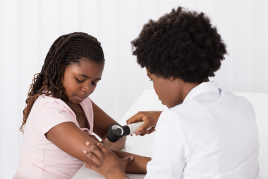
Dermatologists encourage everyone to have this potentially
lifesaving screening. Each year in the United States, more than 1
million new cases of skin cancer are diagnosed, which makes skin
cancer the most common cancer in the nation. With early detection
and proper treatment, skin cancer can be successfully treated.
The purpose of a skin cancer screening is to visually examine the
body for signs of skin cancer. A dermatologist, a dermatologist’s
physician assistant, or a nurse in a dermatologist’s practice should
perform this screening. Specialized training in diagnosing and
treating skin conditions is important. There can be a tendency to
overlook dark lesions on skin of color.
Free Skin Cancer Screenings
To encourage everyone to get screened for skin cancer, the American
Academy of Dermatology offers free skin cancer screenings across the
United States. Many of these screenings take place during May, which
is Skin Cancer Awareness and Detection Month. To find a local
screening, visit:
Free Skin Cancer Screening Program
References:
1 American Academy of Dermatology. "Melanoma in African
Americans." News release issued May 3, 2004,
www.aad.org/media/background/news/skincancer_2004_05_03_melanoma.html.
Last accessed April 24, 2008.
2 Bellows CF, Belafsky P, Fortgang IS et al.
"Melanoma in African-Americans: trends in biological behavior and
clinical characteristics over two decades." J Surg Oncol
2001; 78: 10-6.
3 Gloster HM, Jr., Neal K. "Skin cancer in skin of
color." J Am Acad Dermatol 2006; 55: 741-60; quiz 61-4.
4 Harper A. "New Research Shows Cancer Prevalent in
Darker Skin." Academic Health Center Finding issued by University of
Cincinnati, August 2006,
http://healthnews.uc.edu/publications/findings/?/2981/2983/.
Last accessed April 24, 2008.
5 McCall CO, Chen SC. "Squamous cell carcinoma of the
legs in African Americans." J Am Acad Dermatol 2002; 47:
524-9.
6 Mora RG, Perniciaro C. "Cancer of the skin in blacks.
I. A review of 163 black patients with cutaneous squamous cell
carcinoma." J Am Acad Dermatol 1981; 5: 535-43.
7 Pipitone M, Robinson JK, Camara C et al. "Skin
cancer awareness in suburban employees: a Hispanic perspective."
J Am Acad Dermatol 2002; 47: 118-23.
8 Taylor SC. Dr. Susan Taylor's Brownskin.net. In:
Skin Cancer,
www.brownskin.net/cancer.html. Last accessed April 24, 2008.

An educational program brought to you by the American Academy of
Dermatology. |
 |

|

The reddish spot on this
Asian man's nose is basal cell carcinoma, a type of skin
cancer.

In
skin of color, melanoma often develops on the sole of the
foot. Early treatment is needed to prevent melanoma from
spreading.
Photo
courtesy of dermatologist Calvon O. McCall, MD, FAAD

Early
stage skin cancer, Bowen's disease, appears on this woman's
finger.
Photo courtesy of dermatologist Carl. V. Washington, Jr.,
MD, FAAD

This Latina woman has skin cancer on her nose.
Photo courtesy of dermatologist Miguel R. Sanchez, MD, FAAD

Skin cancer developed on the nose of this Asian Indian man.

The
lesion on this man's lower leg is squamous cell carcinoma (SCC).
SCC is the most common skin cancer in Asian Indians and
blacks.
Photo courtesy of dermatologist Carl V. Washington, Jr., MD,
FAAD
Photographs used with permission of the Journal of the
American Academy of Dermatology.
All photographs were published in the Journal of the
American Academy of Dermatology,
Vol. # 55, Gloster HM and Neal K, “Skin cancer in
skin of color,” 741-60. Copyright Elsevier (2006).
|
 |
|
|
|
|
|