








|
Ask the Dermatologists
My doctor tells me that I have a thin melanoma. What does it
mean to have a thin melanoma?
Hearing that you have a thin melanoma
is generally good news. A thin melanoma is a melanoma that measures
1.0 millimeter (about 1/25 of an inch) or less in thickness1.
Most thin melanomas are considered highly curable when the entire
lesion and a margin of normal-looking skin are removed. With this
treatment, the reported 5-year disease-free survival rate exceeds
90%.
While thickness is the primary factor used to determine a patient’s
prognosis, it is not the only consideration. The patient’s overall
health and other characteristics of the melanoma aside from
thickness play a role. A small percentage of patients with thin
melanomas have had the melanoma recur (return). Often the recurrence
does not happen for several years. Other patients diagnosed with a
thin melanoma have had the melanoma metastasize (spread).
For this reason, doctors consider a number of factors before
determining treatment. Weighing heavily into the treatment decision
are the findings from the biopsy. When examined under a microscope,
some thin melanomas have features that indicate an aggressive
nature. If this is the case, the wide excision — surgery to remove
the entire lesion and a margin of normal-looking skin — may be
followed by another therapy. Called adjuvant therapy, this second
therapy is meant to reduce the risk of the melanoma spreading or
returning.
Some patients diagnosed with an aggressive thin melanoma that
measures between 0.75 and 1.0 millimeters undergo a sentinel lymph
node biopsy (SLNB). This surgery removes lymph nodes nearest the
melanoma so that they can be examined for evidence of cancer. A SLNB
is typically performed at the same time as the wide excision.
Follow-up Care Essential
As melanoma can recur and spread, every patient diagnosed with
melanoma should:
-
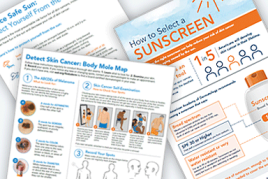
Receive regular follow-up
examinations by a dermatologist
-
Learn how to perform a
self-examination of the skin and lymph nodes
-
Follow a comprehensive
sun-protection plan to protect the skin from harmful ultraviolet
(UV) rays of the sun
-
Never use artificial tanning
devices such as tanning beds
Protecting one’s skin from UV rays
reduces the risk of developing skin cancer and may reduce the risk
of melanoma recurring. Examinations are essential because the
earlier melanoma is detected, the better the prognosis. When limited
to the outermost layers of the skin, melanoma averages a 95% cure
rate.
1 The
thickness of a melanoma is measured during the biopsy when the
lesion is being examined under a microscope. Measured in
millimeters, the thickness tells us how deeply the melanoma has
burrowed into the skin. Also called Breslow thickness, this
measurement is named after Alexander Breslow, MD, the doctor who
created it.
References:
1 Corsetti RL, Allen HM, Wanebo
HJ. Thin < or = 1 mm level III and IV melanomas are higher risk
lesions for regional failure and warrant sentinel lymph node biopsy.
Ann Surg Oncol 2000; 7: 456-60.
2 Kalady MF, White RR, Johnson JL et al. Thin melanomas: predictive
lethal characteristics from a 30-year clinical experience. Annals
of surgery 2003; 238: 528-35; discussion 35-7.
3 Tsao H. The Lethal Thin Melanoma — Wolf in Sheep's Clothing. In:
Journal Watch Dermatology. 2007.

An educational program brought to you by the American Academy of
Dermatology. |
 |
 |
|
Have you ever wished you
could ask a team of dermatologists a question about skin
cancer? Send your question to the
SkinCancerNet Mailbag.
While we value your
questions and ideas, we cannot answer every question.
Only questions about skin cancer will be considered.
A panel of board-certified dermatologists who specialize
in skin cancer will review the questions submitted to
this site and select a few questions. All answers
will appear on the Web site. You will not receive
a reply, so be sure to check this site.
Too busy to check back?
You can learn what new information has been posted,
including questions and answers, by signing up for the
American Academy of Dermatology's
free monthly e-newsletter. |
|
|
|