







|
SkinCancerNet Article
Who is
Most at Risk for Melanoma?
Researchers have identified a number of
risk factors associated with melanoma. These risk factors are
grouped into four categories: environmental, genetic,
immunosuppressive, and previous melanoma. The most common
environmental risk factor is ultraviolet (UV) light emitted by the
sun or an artificial tanning device, such as a tanning bed or sun
lamp. While the sun is a known cancer-causing agent and accounts for
skin cancer development, some melanomas are not sun or UV-light
related. Several inherited traits, including a family history of
melanoma, fair skin, and atypical moles, increase the risk of
developing melanoma.
Most dermatologists believe that these risk factors form a complex
inter-relationship; making it difficult to identify any single risk
factor as the reason a person develops melanoma. There is one
exception — a family history of melanoma. Research shows that when
one close blood relative has had melanoma, the risk of developing
melanoma increases. That risk rises significantly if two or more
blood relatives have had melanoma.
To help you determine your risk factors, this article describes each
risk factor and what you should know if it is a personal risk
factor. The risk factors are grouped by category:
Environmental Risk Factors
Sunlight (solar UV radiation). Overexposure to ultraviolet
(UV) radiation from sunlight significantly increases the risk of
developing skin cancer, including melanoma. One type of melanoma,
lentigo maligna melanoma (LMM), develops in elderly white-skinned
people with a history of chronic sun exposure.
The UV risk increases if you have had:
-
Chronic (long-term) or frequent
exposure to sunlight, whether through an occupation or leisure
activities. Many summers spent at outdoor pools, on the golf course,
or working in the garden without the benefit of sun protection can
be considered “chronic exposure.”
-
Periods of intense exposure to the sun.
Intense exposure occurs when one spends a lot of time outdoors in
the summer or lives in an area that receives high-intensity sun year
round, such as Florida, the Caribbean, or northern Australia.
When overexposure to solar radiation is
combined with other risk factors, such as a family history or
melanoma, fair complexion, or the presence of atypical moles, a
complex inter-relationship occurs. For example, fair skin may not
pose a risk until exposed to intense solar radiation. UV radiation
also may increase the number of acquired pigmented moles and induce
atypical moles to develop melanoma.
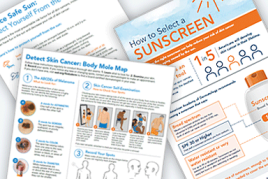
Everyone should practice sun protection. The American Academy
of Dermatology recommends that everyone protect their skin by
following these sun protection practices:
-
Avoid deliberate tanning.
Lying in the sun may feel good, but the end result is premature
aging (wrinkles, blotchiness, and sagging skin) as well as a 1 in 5
chance of developing skin cancer. Tanning beds and sunlamps are just
as dangerous because they, too, emit enough UV radiation to cause
premature aging and skin cancer. If you like the look of a tan,
there are plenty of sunless tanning lotions on the market today that
create a natural look and do not turn your skin orange.
-
Stay out of the sun between 10:00
a.m. and 4 p.m.
This is when the sun’s rays are strongest.
-
Seek shade whenever possible.
Be sure to slip into the shade whenever possible.
-
Use broad-spectrum sunscreen with a
Sun Protection Factor (SPF) of 15 or higher. Most people do not
apply enough sunscreen to help protect against harmful UV radiation.
One ounce, enough to fill a shot glass, is considered the amount
needed to cover the exposed areas of the body properly. So when
applying sunscreen, remember to apply it liberally. Here are a few
more tips for using sunscreen:
-
When shopping for sunscreen, buy one
that is broad-spectrum. “Broad-spectrum” means that the sunscreen
protects against the UVA and UVB rays.
-
If you will be in the sun for more than
20 minutes, apply a broad-spectrum sunscreen with an SPF of 15 or
higher to all skin that will be exposed. This provides basic
year-round protection.
-
Don’t forget your ears, nose, neck,
hands, and toes. Many skin cancers develop in these areas. Protect
your lips, another high-risk area, with lip balm that offers sun
protection with an SPF of 15 or higher.
-
Sunscreen should not be used to prolong
sun exposure – only to avoid sunburn. Some UV light gets through
sunscreen.
-
Sunscreens should be applied to dry
skin 15-30 minutes before going outdoors, even on cloudy days. Be
sure to reapply it every two hours.
-
Be sure to reapply sunscreen after
being in water or sweating.
-
Sunscreen does not make sunbathing
safe.
-
Cover up when you must be in the
sun.
When you will be out in the sun, be sure to wear protective
clothing, such as a shirt, and a wide-brimmed hat. Here’s why:
-
Clothing protects your skin from the
sun’s harmful rays. The tighter the weave, the more sun
protection provided. In fact, clothing plays such an important role
in sun protection that clothing designed specifically to protect
against the sun as well as laundry additives created to boost
clothing’s protective function are available. Your dermatologist may
be able to provide you with more information about these products.
-
A wide-brimmed hat shades your face
and neck from the sun’s rays. Wide-brimmed means the brim
extends around the entire hat and shades your face and neck.
-
Wear sunglasses that provide 100% UV
protection.
When buying sunglasses, look for products that provide “100% UV
protection.”
Chemical and occupational
carcinogens. No chemical or occupational carcinogen has been
shown to be a risk factor for melanoma. While some studies indicate
increased risk in certain chemical industry occupations, these
studies have not been able to separate recreational sun exposure and
other melanoma risk factors from occupational exposure to suspected
chemicals.
Genetic Risk Factors
Genetic risk factors are believed to most strongly correlate to
a person’s risk of developing melanoma. These risk factors include a
family history of melanoma; moles; and the color of your skin, hair,
and eyes.
Family History of Melanoma. Between 5% and 10% of people who
develop melanoma have a close blood relative, such as a parent,
brother, sister, child, grandparent, aunt or uncle, who developed
melanoma.
Inheriting a tendency to develop melanoma is more complex than
inheriting a single "melanoma gene." Research is being conducted to
determine exactly how melanoma is inherited. It is now known that
when a first-degree blood relative (e.g., parent, child, or sibling)
develops melanoma, there is an increased risk for developing
melanoma. This risk increases significantly if multiple more-distant
relatives also have a history of melanoma.
If family history is a personal risk factor: Anyone with a
family history of melanoma should perform regular self-examinations
of their skin and be screened by a dermatologist regularly. If
self-examination reveals a suspicious lesion, make an appointment to
see a dermatologist and let the person scheduling the appointment
know why you are making the appointment.
Moles. Several studies have shown an increased risk for
melanoma when a person has:
People with a larger than average
number of moles (50 plus) are at greater risk for developing
melanoma.
Researchers have also found that one-third of non-familial melanomas
develop in atypical moles — what dermatologists call “dysplastic
nevi.” A dysplastic nevus is characterized by the ABCDs of Melanoma
Detection. It is asymmetrical (if you were to fold the lesion in
half, the two parts would not match), borders are poorly defined or
irregular, color within mole varies, and the diameter tends to be 6
millimeters (about the size of a pencil eraser) or larger when
diagnosed. However, melanomas can be smaller. If you notice a mole
different from others, or which changes, itches, or bleeds even if
it is smaller than 6 millimeters, you should see a dermatologist.
A study of 716 newly diagnosed melanoma patients found that about
half of them had numerous dysplastic nevi. This large-scale study
confirmed observations made since 1978 that indicate an association
between the presence of numerous dysplastic nevi and an increased
risk for melanoma. During the study, researchers calculated a
person’s risk based on the type and number of moles present. Their
conclusions are shown in Table 1.
|
Characteristic of Mole |
Risk of
Getting Melanoma (anywhere on the skin) |
|
1
dysplastic nevi |
2-fold
increase |
|
10+
dysplastic nevi |
14-fold
increase |
|
Large
number of small normal moles |
2-fold
increase |
|
Large
number of small and large
normal moles |
4-fold
increase |
Table 1 – Study Found Melanoma Risk
Increases
with Type and Number of Moles
It is estimated that between 2% and 4%
of white adults have at least one dysplastic nevus. People with
dysplastic nevi are likely to have moles on the scalp, pubic area,
and breasts. Dysplastic nevi occur with far less frequency in
African-Americans and Asians.
A person’s risk for developing melanoma increases significantly when
the person has atypical moles and a family history of melanoma.
According to the American Cancer Society, “a person with one or more
dysplastic nevi and at least 2 close relatives with melanoma has a
50% greater risk of developing melanoma.”
About 3% to 8% of non-familial melanomas develop in a congenital
mole. The size of this mole appears to be an important risk factor —
the larger the mole, the greater the risk. This does not mean that
melanoma never develops in small congenital moles; however, moles
known as giant congenital nevi pose significantly greater risk for
malignant change — about 15% over a lifetime. A giant congenital
nevus is shown in this photo:
A giant congenital nevus, such as the one shown in this
photo, poses significant risk for malignant change —about 15%
over a lifetime.
(Photo used with
permission of the American Academy of Dermatology National
Library of Dermatologic Teaching Slides) |

|
Melanoma also can develop in acquired
(not present at birth) moles. Approximately 40% of 3-year-old
children have at least one acquired mole. About 90% of white adults
and 70% of non-white adults have one or more acquired moles.
Since exposure to the sun suppresses the immune system, moles
subject to sunburn or repeated sun exposure may be at greatest risk.
However, moles also can develop in areas seldom exposed to direct
sunlight, such as the buttocks or inside of the thighs. In fact, an
acquired nevus does not necessarily have to be exposed to
ultraviolet radiation to undergo malignant change.
If moles are a personal risk factor: Anyone who has a large
number of moles or atypical moles and has never been screened by a
dermatologist should make an appointment to be screened.
Dermatologists recommend that anyone diagnosed with atypical moles
perform regular self-examinations and be examined once every 6
months.
Color of skin, hair, and eyes. The color of a person’s skin,
hair, and eyes is clearly linked to the risk of developing melanoma.
Characteristics of light pigmentation that increase the risk of
developing melanoma are:
-
Fair skin
-
Blond or red hair
-
Blue, green, or gray eyes
-
Sensitivity to ultraviolet radiation
(likely to burn rather than tan with initial and repeated exposure
to sunlight)
-
Tendency to freckle or form pigmented
moles with sun exposure
If you tan poorly, do not tan at all,
or tend to form freckles and pigmented moles with sun exposure, you
have a 2-to 3-fold increased risk of developing melanoma.
It is important to know that melanoma develops in all races. While
there is a 20-fold decreased risk in dark-skinned individuals with
no predisposing family history of melanoma, melanoma does occur. One
type of melanoma, acral lentiginous melanoma (ALM), accounts for 50%
of all melanomas that arise in dark skin. Some consider ALM a
“hidden” melanoma because it develops in places not easily examined
or not thought necessary to examine. ALM is found on the palms and
soles; underneath nails; and on mucous membranes, such as those that
line the mouth, nose, and anus. In its early stages, ALM is often
overlooked because it looks like a bruise or nail streak.
If light pigmentation is a personal risk factor: Anyone with
light pigmentation is strongly urged to follow sun-protection
practices and perform regular self-examinations.
Xeroderma pigmentosum. Certain inherited skin conditions,
such as xeroderma pigmentosum, are associated with an increased risk
for melanoma. Xeroderma pigmentosum is an extremely rare genetic
disorder caused by a defect in the enzyme that repairs damage to
DNA, making the person unable to repair ultraviolet B-induced DNA
damage. This increases the risk for both melanoma and nonmelanoma
skin cancer. People with xeroderma pigmentosum are extremely
sensitivite to ultraviolet light.
If xeroderma pigmentosum is a personal risk factor: Anyone
with xeroderma pigmentosum should be under the care of a
dermatologist.
Immunosuppressive Risk Factors
Suppressing the immune system limits the body’s ability to recognize
cancer cells and eliminate them. Research shows that
immunosuppression (suppression of the immune system) is associated
with a 4-to 5-fold increased risk of developing melanoma. The risk
increases if the person has one or more atypical moles or has
already had melanoma.
Diseases that suppress the immune system and may increase the risk
of developing melanoma include acquired immunodeficiency syndrome
(AIDS) and some lymphomas. Medication that retards or prevents organ
rejection after a transplant also increases the risk of developing
melanoma because such medications suppress the immune system.
If immunosuppression is a personal risk factor: Anyone with this
risk factor should be under the care of a dermatologist because immunosuppression greatly increases one’s risk of developing skin
cancer.
Previous Melanoma: A Risk Factor
Between 5 and 10% of people who develop one melanoma will develop
another independent melanoma.
If previous melanoma is a personal risk factor: Anyone who has had
melanoma should perform self-examinations as recommended by their
dermatologist, keep all appointments for screenings, and practice
sun-protection practices.
Who’s most at risk?
Melanoma’s many risk factors form a complex inter-relationship.
Those most at risk tend to have one or more of the genetic risk
factors described above. When genetic risks factors are combined
with other risk factors, such as overexposure to sunlight or
immunosuppression, the potential risk rises.
References:
Johnson, TM et al. “Multiple primary melanomas.” Journal of the
American Academy of Dermatology. 1998;39(3):422-7
Tucker MA et al. “Clinically recognized dysplastic nevi. A central
risk factor for cutaneous melanoma.” Journal of the American Medical
Association, 1997; 277:1439-44.

An educational program brought to you by the American Academy of
Dermatology. |
 |
|