






|
SkinCancerNet Article
More
Young Patients Hearing “You Have Skin Cancer”
|
Quick View:
More and more people under the age of 40 are being diagnosed
with nonmelanoma skin cancer. This article explains what
researchers believe is causing the increase and offers steps
you can take to help prevent skin cancer. |
While most cancers
in the United States have been declining, the number of new skin
cancer cases continues to grow. Each year, more than 1 million
Americans learn that they have nonmelanoma skin cancer. Most cases
of nonmelanoma skin cancer are basal cell carcinoma (BCC), followed
by squamous cell carcinoma (SCC).
As years of
unprotected sun exposure is a known cause of skin cancer and the
risk of developing skin cancer increases with age, most diagnoses
are made in people over 50 years of age. Across the United States,
skin cancer rates continue to increase rapidly in this age group.
However, people
over 50 may not be the only ones developing dramatically more skin
cancers. A study published in the Journal of the American Medical
Association reports that between 1976 and 2003, the incidence of
nonmelanoma skin cancer in patients under 40 years of age increased
significantly in Olmstead County, a county located in southeastern
Minnesota.
This finding
coincides with a trend that many dermatologists across the United
States are seeing in their practices. More and more often, they are
diagnosing patients who are in their 30s, 20s, and even teens with
nonmelanoma skin cancer.
What’s causing this
rise in skin cancer?
Researchers agree that advanced age combined with years of
unprotected sun exposure is not causing the increase in skin cancer
among people younger than 40. Findings from the Olmstead County
study and other research suggest that the following may be
contributing to the rise:
-
Tanning bed use.
Research shows that young women, who tend to use tanning beds much
more frequently than young men, have an increased risk of
developing nonmelanoma skin cancer with tanning bed use.
Most tanning salons use bulbs in their tanning beds that emit a
significant amount of ultraviolet A (UVA) and ultraviolet B (UVB)
radiation. Ultraviolet (UV) rays are the primary cause of skin
cancer.
In fact, the
United States Department of Health and Human Services lists UV
radiation as a known carcinogen (cancer-causing agent).
-
More time spent
tanning.
Data shows that about 80% to 90% of diagnosed nonmelanoma skin
cancers occur on the head and neck in adults. However, researchers
in Minnesota found that the younger patients developed more BCCs
on their torsos. Other studies also have found that younger
patients tend to develop more nonmelanoma skin cancers on their
torsos. This trend suggests that younger patients are spending
more time outdoors tanning. Increased use of tanning beds also may
be contributing to the rise in nonmelanoma skin cancers on
patients’ torsos.
-
Intense
intermittent sun exposure.
This is a
known risk factor for melanoma. Now researchers suspect that short
but intense exposure to the sun — such as seeking a tan during a
tropical vacation or spending summer weekends outdoors without
adequate sun protection — may be contributing to the increase in
nonmelanoma skin cancer, especially in people younger than 40.
-
Patient’s body
may be less able to repair damage caused by exposure to
ultraviolet (UV) rays.
The sun’s rays and indoor tanning devices, such as tanning beds,
emit UV light. While we do not feel or see this light when it hits
our skin, exposure to UV light damages our DNA. The human body can
repair this damage. However, with repeat exposure to UV light, the
damage eventually outpaces repair. One research study suggests
that young patients who are developing skin cancer may have less
capacity to repair their damaged DNA.
-
Smoking.
Tobacco use is a known risk factor for SCC. Studies have found
that cigarette and pipe smoking in particular increase one’s risk
of developing SCC. The researchers in Minnesota also found this to
be true. More than half of the patients who developed SCC were
smokers or had smoked in the past.
Other research studies have found that women between the ages of
20 and 40 who have developed BCC are more likely to smoke or to be
former smokers. However, the study conducted in Minnesota
did not find this correlation.
-
Ozone depletion.
Earth’s atmosphere contains an ozone layer. This ozone layer helps
shield the planet from the sun’s UVB rays. However, years of using
aerosol sprays, refrigerants, and other products that contain
chlorofluorocarbons has created a hole in the ozone layer. Each
year this hole grows, and more UVB light reaches Earth. Exposure
to UVB is known to cause nonmelanoma skin cancer as well as play a
key role in the development of melanoma.
-
Growing awareness
of skin cancer.
Researchers believe that the public’s increased awareness of skin
cancer may be resulting in more diagnosis.
Skin Cancer
Prevention
Regardless of your age, most skin cancer can be prevented by
practicing sun protection. Research shows that sun protection also
can help prevent skin cancer from recurring once a person has been
diagnosed.
Sun exposure is the most
preventable risk factor for all skin cancers, including melanoma.
You can have fun in the sun and decrease your risk of skin cancer.
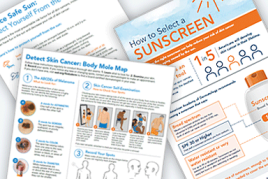
Here's how to Be Sun
SmartSM.
-
Generously apply water-resistant sunscreen with a Sun
Protection Factor (SPF) of at least 30 that provides broad-spectrum
protection from both ultraviolet A (UVA) and ultraviolet B (UVB) rays to
all exposed skin. Re-apply approximately every two hours, even on cloudy days,
and after swimming or sweating. Look for the AAD SEAL OF
RECOGNITION™ on products that meet these criteria.
-
Wear
protective clothing, such as a long-sleeved shirt, pants, a
wide-brimmed hat and sunglasses, where possible.
-
Seek
shade when appropriate, remembering that the sun’s rays are
strongest between 10 a.m. and 4 p.m. If your shadow is shorter
than you are, seek shade.
-
Protect children from sun exposure by playing in the shade,
using protective clothing, and applying sunscreen.
-
Use
extra caution near water, snow and sand as they reflect the
damaging rays of the sun which can increase your chance of sunburn.
-
Get
vitamin D safely through a healthy diet that includes vitamin
supplements. Don’t seek the sun.
-
Avoid
tanning beds. Ultraviolet light from the sun and tanning beds
can cause skin cancer and wrinkling. If you want to look like you’ve been
in the sun, consider using a sunless self-tanning product, but continue
to use sunscreen with it.
-
Check
your birthday suit on your birthday. If you notice anything
changing, growing, or bleeding on your skin, see a dermatologist. Skin
cancer is very treatable when caught early.
If You Like the
Look of a Tan
A
survey conducted by the American Academy of Dermatology (Academy) in
2005 found that the majority (66%) of teens said they think people
look better with a tan. A similar study conducted by the Academy
found that 61% of women and 69% of men age 18 and older replied that
they think people look better with a tan.
If you really want
the look of a tan, dermatologists recommend using a self-tanning
lotion. There are many fine products available today. When using a
self-tanning lotion, it is important to remember that you also need
to use sunscreen. Dermatologists recommend daily use of a
broad-spectrum sunscreen with an SPF of 30 or higher when using a
self-tanning lotion.
References:
American Academy of Dermatology. “New Survey Shows Teenagers Know
Sun Exposure is Dangerous, Yet Most Still Want a Tan.”
May 2, 2005. Last accessed February 15, 2006.
American Academy of Dermatology.
“Dermatologists
Encourage Consumers to be "Clothes" Minded When it Comes to
Selecting Summer Wardrobe.” May 2, 2005. Last accessed February 15,
2006.
American Academy of Dermatology. “New Survey Finds Majority of Women
Still Associate a Tan With Beauty and Health.” May 2, 2005. Last
accessed February 15, 2006.
Christenson LJ et al. “Incidence of Basal Cell and Squamous Cell
Carcinomas in a Population Younger than 40 Years.” Journal of the
American Medical Association. 2005 August 10;294(6):681-90.
De Hertog SAE et al.
“Relation
Between Smoking and Skin Cancer.” Journal of Clinical Oncology.
2001 January; 19(1):231-38.
Saraiya M et al.
“Interventions to Prevent Skin Cancer by Reducing Exposure to
Ultraviolet Radiation.” American Journal of Preventive Medicine.
2004 December; 27(5):422-66.

All
content solely developed by the American Academy of Dermatology |
 |
 |
|
Dermatologists
caution, “It’s never okay to use a tanning bed or ‘lay
out’ in the sun — even before a special occasion, such
as a prom or wedding.”
If you want to look tan, use a self-tanning lotion. When
using a self-tanning lotion, be sure to apply sunscreen
daily. |
|
|
|